 Tigran Grigoryan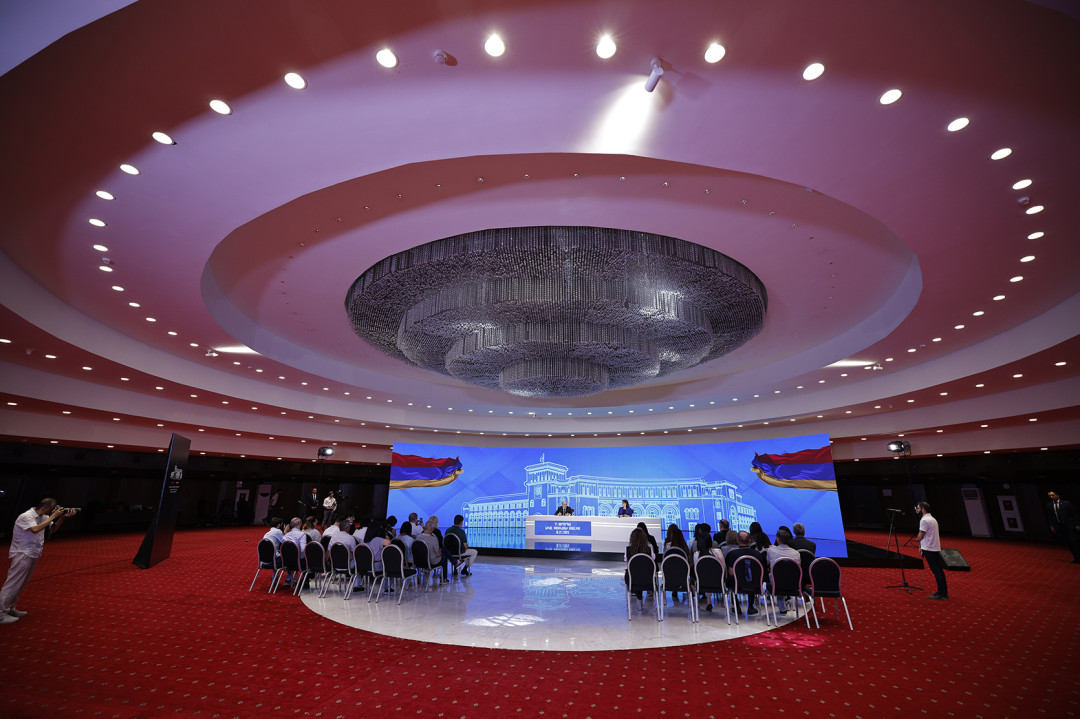
In a nearly five-hour marathon press conference on July 16, Armenian Prime Minister Nikol Pashinyan addressed a wide array of political and regional issues. Among the most significant topics was the long-discussed American proposal of unblocking regional transport routes, particularly the construction of a railway through Armenia’s Syunik region, which would connect mainland Azerbaijan with its exclave, Nakhichevan.
Information about this proposal first appeared weeks ago in an article published by the Carnegie Endowment for International Peace and was later confirmed by Armenian journalists. This proposal was likely one of the central topics discussed by the leaders of Armenia and Azerbaijan during their recent bilateral meeting in Abu Dhabi. As the meeting took place, Armenia’s Deputy Foreign Minister, Mnatsakan Safaryan, publicly stated that Yerevan does not exclude the possibility of involving a third-party private company to facilitate transit through southern Armenia. The debate intensified further after a statement by U.S. Ambassador to Turkey Thomas Barrack, who hinted that the Syunik route could be leased to the United States for 100 years.
These latest developments in the regional communications agenda are a direct consequence of the Trump administration’s engagement. During my recent three-week trip to the United States, I had the opportunity to discuss this issue with various stakeholders. The initiative is being spearheaded by President Trump’s special envoy, Steve Witkoff, who proposed the idea to both sides and has been actively involved in the matter over the past several months. The process is also being closely monitored by senior figures in the administration, including Vice President J.D. Vance. President Trump himself recently spoke publicly about the potential Armenia–Azerbaijan agreement.
While there is still limited public information about the specifics of the American proposal, Pashinyan’s press conference offered some clarity regarding its essence. In what appeared to be a tacit confirmation, the prime minister acknowledged that the main proposal under discussion is indeed the one reported in the media: an American initiative that envisions outsourcing the construction, operation, and possibly the security of the railway route to a U.S. company.
But beyond confirming the proposal, the real significance of the press conference lies in what was left unsaid – or rather, what has quietly disappeared from Armenia’s diplomatic vocabulary. Notably, in multiple answers on the issue of unblocking, Pashinyan made no mention of the principle of reciprocity. This principle, long considered a foundational element of Armenia’s approach to regional connectivity, stipulates that any special arrangements on Armenian territory must be mirrored by corresponding arrangements on Azerbaijani soil.
Even as Pashinyan spoke of Armenia’s interest in using Azerbaijani territory – specifically Nakhichevan – to connect Meghri with Yeraskh by rail, there has been no indication that Azerbaijan is prepared to accept similar third-party arrangements or any oversight resembling what is now being considered in Syunik.
This suggests a broader shift in Armenia’s posture – one increasingly resigned to asymmetric compromises dictated by the post-2020 power imbalance. Reciprocity was once the central counterweight to Azerbaijan’s demand for a “corridor”; it offered a way to balance access with sovereignty. Now, by omitting it entirely, the Armenian government appears to be signaling that it no longer insists on mutuality, even in principle.
Another rhetorical pivot came in Pashinyan’s comments on the word “corridor.” For years, that term has triggered intense political reactions in Armenia, especially in the aftermath of the 2020 war and Aliyev’s repeated use of the phrase “Zangezur Corridor” to suggest an extraterritorial route. Pashinyan himself has been one of the most vocal opponents of the term.
Yet during this latest press conference, Pashinyan downplayed the emotional and political weight of the term. He argued that “corridor” should not be taken too literally and referenced examples like the North–South road in Armenia, whose official name is the North–South transport corridor. In doing so, he repeated almost verbatim the same argument Azerbaijani President Ilham Aliyev had made during earlier meetings – arguments that Armenian officials once rejected outright.
Coming back to the proposal, it raises the risk of asymmetric outcomes. For example, the American proposal, as currently described – outsourcing construction and operations to a U.S. company – would most likely apply solely to Armenian territory. In practical terms, this would mean Armenia relinquishing a degree of operational control over a strategic transport route without any reciprocal gain. Even if Armenian sovereignty is formally preserved, real control could be compromised in practice.
The other potential risk is that, after reaching an agreement about special arrangements on this route, Azerbaijan might not have the incentive to complete the full unblocking of communications that existed in the Soviet period. We have this example with the delimitation process: when Armenia made unilateral concessions in spring 2024, the delimitation process began but has been stalling since. The sides haven’t been able to continue the process even in the less controversial parts of the mutual border.
The Armenian government’s willingness to get on board with this proposal is conditioned by several factors. Firstly, Yerevan might view this proposal as the lesser of existing evils – the other options being either Russian control or Azerbaijani coercion. Baku has been rapidly building its section of the railway that will soon reach the border with Armenia. Furthermore, this potential deal is reflective of the Trump administration’s approaches and interests. Similar to Ukraine’s mineral deal, Armenia hopes that direct U.S. involvement and presence would be a security guarantee in itself.
Things are more complicated when it comes to Azerbaijan’s calculations. In recent years, Baku has actively sought to limit Western involvement in the South Caucasus. It opposed the European Union’s monitoring mission in Armenia and ultimately pressured Yerevan into agreeing to its withdrawal in the text of the peace treaty. Pro-government commentators in Azerbaijan have also raised concerns about the potential strain on Baku’s relationship with Iran that could result from accepting a visible American presence along this sensitive stretch of the border. These considerations suggest that Azerbaijan may be reluctant to support the U.S. proposal.
At the same time, outright rejection would carry its own risks. Baku has been making efforts to improve ties with the Trump administration and elevate the bilateral relationship. Turning down an initiative that Washington sees as a potential easy win in foreign policy could jeopardize that broader diplomatic agenda.


 Stories