 Civilnet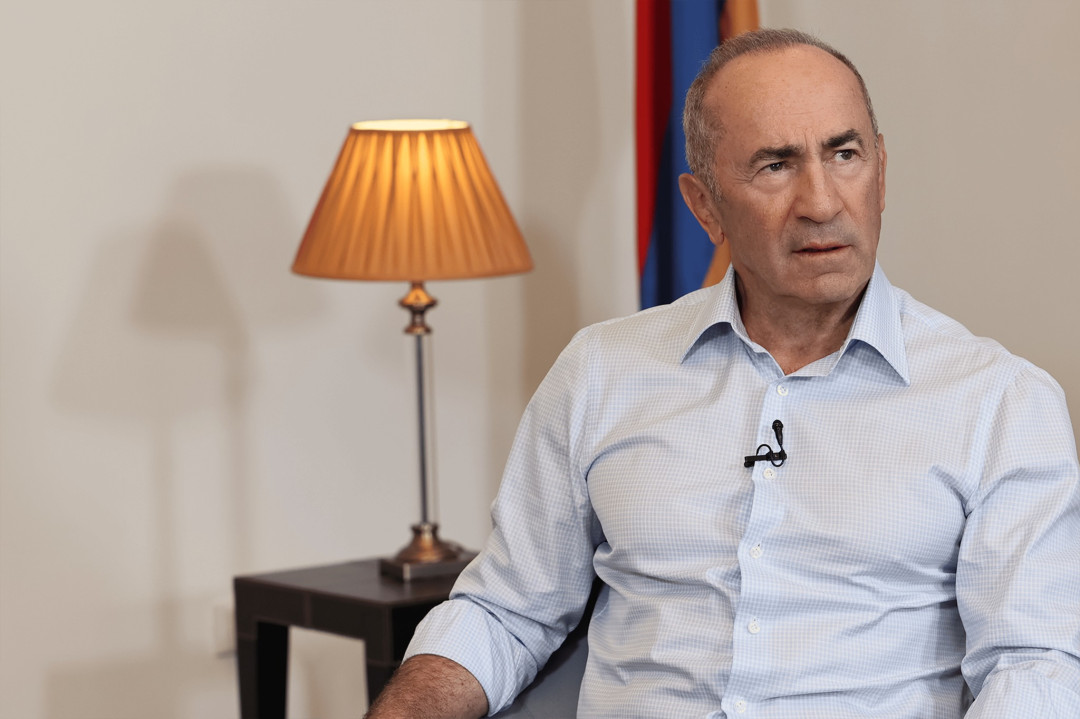
By Siranush Adamyan
Former Armenian President Robert Kocharyan has condemned ongoing negotiations over a proposed transit route through Syunik province as a “diplomatic catastrophe,” arguing that continued talks over what Baku calls the “Zangezur corridor” defy both logic and national interest.
Speaking in a televised interview on Friday with the 5th TV Channel—a network he owns—Kocharyan said the issue should have been removed from the negotiating table the moment Nagorno-Karabakh was lost to Azerbaijan. “The fact that this so-called corridor is still being discussed is nothing short of a colossal diplomatic failure,” he said. “The Lachin corridor no longer exists. So why should Armenia still be negotiating a so-called symmetric arrangement?”
Kocharyan said the basis for this arrangement lies in the ninth clause of the November 9, 2020 trilateral ceasefire statement, which was inserted at Azerbaijan’s insistence to create a parallel to the Lachin corridor. That clause referred to unblocking communications between Azerbaijan and its exclave Nakhichevan via Armenian territory. But, he argued, the logic behind it has collapsed.
“Clause 9 was designed to mirror Lachin—a five-kilometer-wide corridor beyond Armenia’s control. But Lachin is gone, Karabakh is gone, and yet the idea of a corridor through Armenia has taken on a life of its own,” he said. “This is the very definition of diplomatic failure.”
Kocharyan further warned that the current version of the proposed route has nothing to do with reopening regional transport links for mutual benefit. Instead, he said, it is being designed as a strategic corridor for Turkey, Azerbaijan, and Central Asia—bypassing Armenia entirely. “This road will not integrate Armenia—it will isolate it,” he said.
Kocharyan accused the Pashinyan government of turning Armenian territory into a bargaining chip in negotiations between foreign powers. “When other countries are discussing a transit corridor through your sovereign land, and you are not even at the table, it means you’ve become the menu,” he said.
He also dismissed the government’s openness to third-party management of the route, potentially by a U.S.-based logistics company. Prime Minister Nikol Pashinyan recently compared the idea to the concession model used for Yerevan’s Zvartnots airport.
“Zvartnots is a commercial facility. A road cutting through Syunik is a matter of sovereignty and law enforcement,” Kocharyan countered. “If there’s an accident, who investigates? If there’s a crime, which court has jurisdiction? Outsourcing such control is not business—it’s state abdication.”
Kocharyan alleged that backdoor deals may already be in place, referencing the July 10 meeting between Pashinyan and Azerbaijani President Ilham Aliyev in Abu Dhabi. He noted that Turkish President Recep Tayyip Erdogan’s announcement of a $2.8 billion railway project from Kars to Nakhichevan suggests that Ankara and Baku are proceeding with plans that bypass Armenian involvement entirely.
“This isn’t about regional cooperation anymore—it’s about being bypassed, excluded, and erased,” Kocharyan said.
He further accused Pashinyan of misleading the Armenian public by gradually redefining core national narratives. “First it was ‘Artsakh is Armenia.’ Then it became ‘we lost Artsakh but saved Armenia.’ That’s like losing a limb in an accident and claiming it helped with weight loss,” he said.
Calling the prime minister a “biomechanical device programmed to lie,” Kocharyan warned that the government was conditioning the public to accept strategic concessions as victories. “He doesn’t just mislead—he trains the public to accept defeat as progress,” he said.
The Armenian government continues to insist that any future transit arrangement will remain fully under Armenian sovereignty and legal jurisdiction.



 Stories