 Civilnet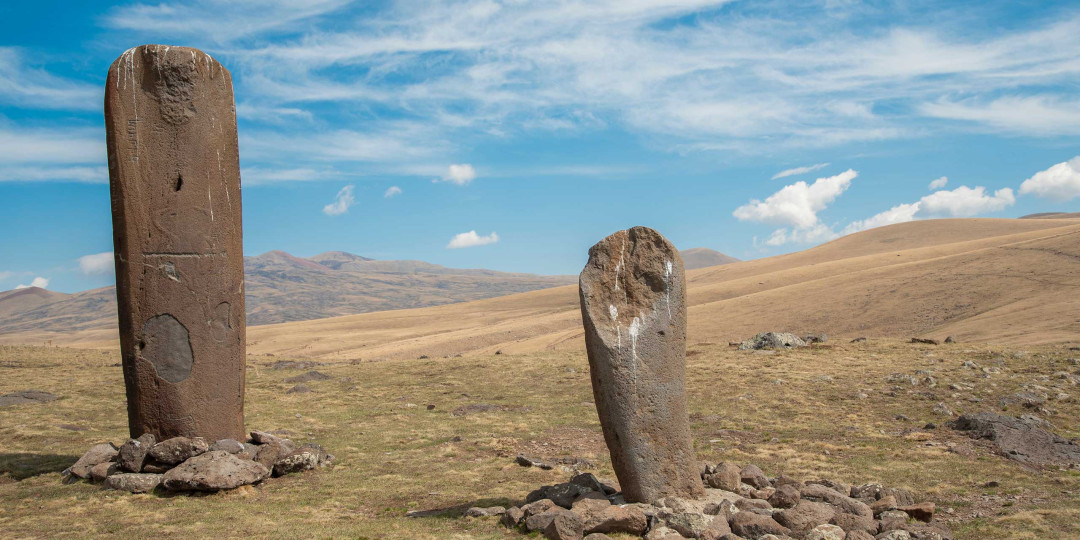
By Alexander Pracht
A group of Armenian and European archaeologists revealed earlier this month new findings on Armenia’s prehistoric “dragon stones,” also known as vishapakars, in a study published in the npg Heritage Science journal. The research, a comprehensive statistical analysis, suggests the giant monuments were part of an ancient water cult dating back to the Copper Age.
“The findings support the hypothesis that vishaps were closely associated with an ancient water cult, as they are predominantly situated near water sources, including high-altitude springs and discovered prehistoric irrigation systems,” the paper said.
Carved from local andesite and basalt, vishapakars are up to 18 feet tall and bear animal motifs. They are mostly found toppled on the ground across Armenia, southern Georgia, and eastern Turkey, though their undecorated “tails” indicate they originally stood upright. Dating them is difficult, as they were often placed far from ancient settlements. However, examples discovered on Mount Aragats are thought to date to around 4200–4000 BC.
The study notes that many vishapakars were later reused and reinterpreted, bearing inscriptions in Urartian, a language spoken in this region between the 9th and 6th centuries BC, and even in the Armenian alphabet as late as the 13th century AD. Researchers argue that their deliberate placement near high-altitude summits, the main snow reservoirs sustaining valley life in summer, shows both practical and symbolic importance, sacralizing the origins of water.
Although the term “dragon stones” may appear puzzling given their water cult associations, most depict fish or other animals, which ancient people may have perceived as akin to serpents or reptiles. The dragon naming is a later interpretation; the monuments’ original designation is unknown.
It is widely believed that vishapakars later inspired Armenia’s khachkars, or cross-stones. Those are large carved slabs bearing a cross, inscriptions, and intricate, highly detailed patterns that have been created since the country’s adoption of Christianity and continue to be produced today.
The study also highlights the broader cultural significance of vishapakars. More than 6,000 years ago, highland communities showed a remarkable willingness to devote immense energy to a non-utilitarian project, an effort that involved not only carving the massive stones, but also transporting them to high mountain elevations. The locations of the findings suggest the dragonstones were not simply erected where the stone was quarried, but were deliberately carved elsewhere and brought to sacred water sources in the mountains.
The paper is authored by Vahe Gurzadyan and Arsen Bobokhyan of Yerevan State University, with contributions from colleagues at the Free University of Berlin, Ca’ Foscari University in Venice, Italy, and Cornell University in New York.





 Stories