 Civilnet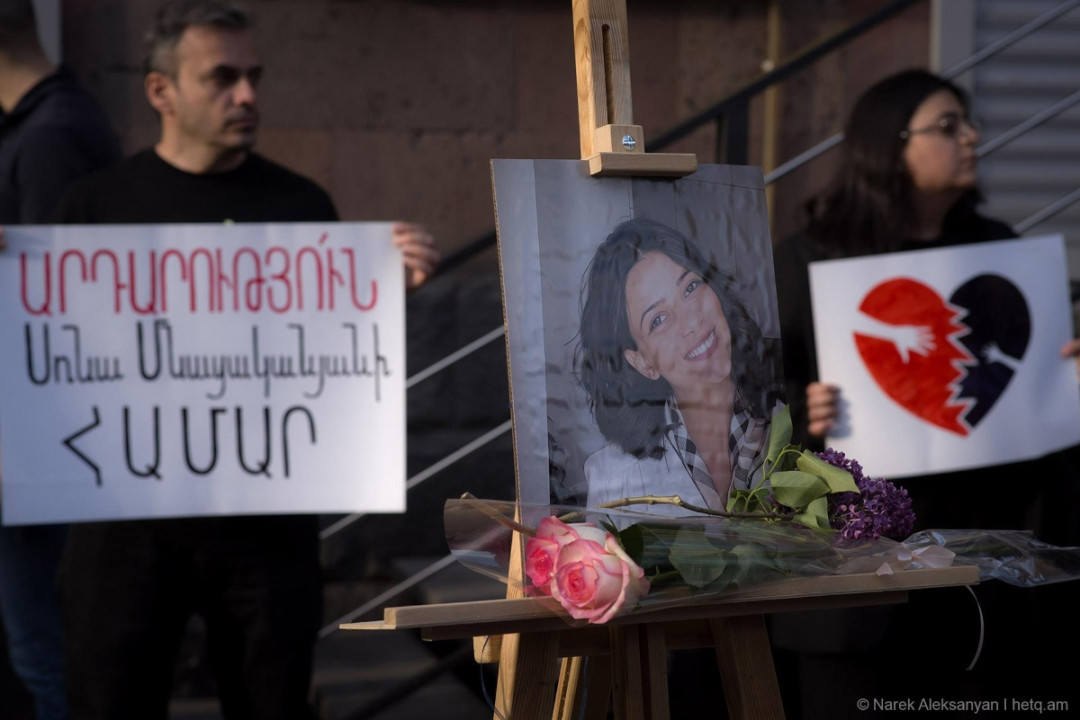
By Gevorg Tosunyan
The police officer convicted over the 2022 death of Sona Mnatsakanyan, a pregnant woman killed by a car in Prime Minister Nikol Pashinyan’s motorcade, remains free and continues to serve in the police force, according to the victim’s family lawyer.
Raffi Aslanyan, the family’s legal representative, told CivilNet that the verdict against Major Aram Navasardyan—who led the prime minister’s escort unit—was delivered on August 18, 2024, but has still not been formally served to the parties. He said the delay fits a “pattern of deliberate prolongation” in a case that has dragged on for more than three years.
Judge Karen Farkhoyan sentenced Navasardyan to one and a half years in prison and suspended his driving license for the same period. Yet, because the ruling has not entered into legal force, the officer remains at liberty and continues to work in the same police department.
The fatal collision took place on April 26, 2022, when a Toyota Prado from Pashinyan’s convoy struck Mnatsakanyan—then 31 weeks pregnant—at the intersection of Leo and Paronyan streets in central Yerevan. Witnesses said none of the convoy vehicles stopped to render assistance.
Investigators found that Navasardyan was driving at roughly 109 km/h, well above the speed limit, and failed to brake before hitting Mnatsakanyan, who was crossing on a green light. She and her unborn child died instantly.
Public anger over the handling of the case has persisted amid claims of official interference and missing evidence, including deleted radio communications between convoy vehicles.
In a July 16, 2025 press conference in Yerevan, Prime Minister Pashinyan defended himself against accusations of political meddling, saying he bore no personal responsibility for the crash. He likened his role in the incident to that of a bus passenger, remarking: “My convoy is not my convoy—it’s like a state bus. I was sitting in my car, and three cars away, a very tragic event occurred. I called to express condolences, but I wasn’t even a witness to it.”
Mnatsakanyan’s family and lawyer argue that if the intersection had been properly closed before the convoy passed, the crash could have been avoided. They also accuse authorities of shielding higher-ranking officials from accountability.
Mnatsakanyan, 29, was a project coordinator at the Tufenkian Foundation in Nagorno-Karabakh and co-founded the NGO Support Our Heroes. Her death drew widespread public outcry and prompted statements from foreign lawmakers urging Armenia to ensure equal application of the law “regardless of rank or position.”
Aslanyan warned that with the statute of limitations expiring in 2027, continued procedural delays risk rendering the punishment unenforceable. “When it serves the government’s interests, justice in Armenia moves swiftly,” he said. “But in this case, it has been stalled for years.”





 Stories