 Civilnet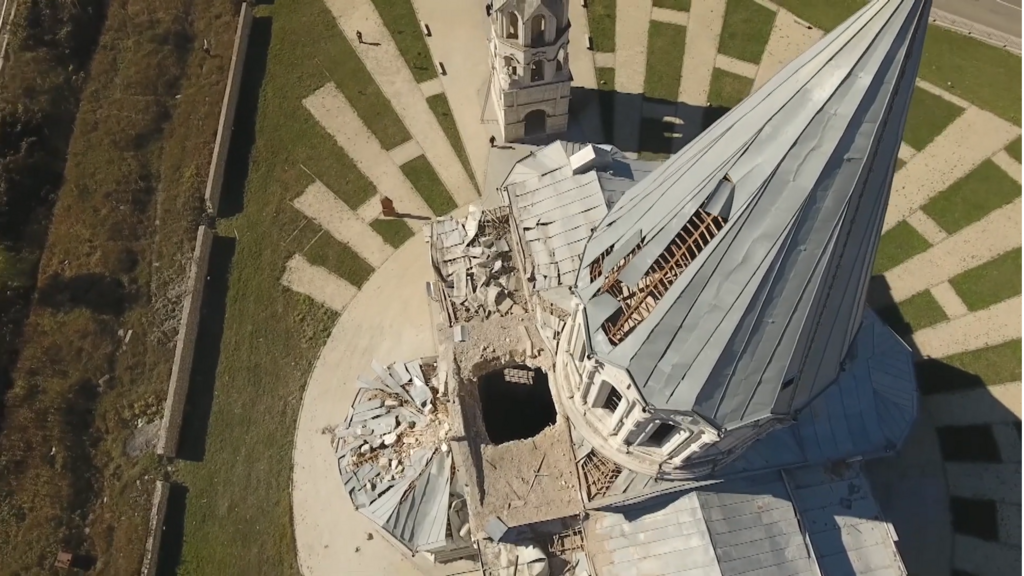
By Paul Vartan Sookiasian
The 44 Day War in 2020, during which Azerbaijan attacked the Armenians of Karabakh, brought widespread destruction to cultural monuments. The complete expulsion of Armenians from the formerly self-governing region in 2023 left behind hundreds of cultural and religious monuments now facing danger. Because these sites are now completely inaccessible to independent observers and experts, the Cornell-based research initiative Caucasus Heritage Watch (CHW) has continued to monitor the condition of 500 Armenian cultural heritage sites in Karabakh through satellite images.
An ongoing crowdfunding campaign seeks to defray the cost of ‘satellite tasking’, the commissioning of satellites to capture new imagery of specific locations for monitoring work.
As CHW co-founder and Cornell professor Dr. Lori Khatchadourian explained to CivilNet, while satellite tasking is costly, it provides a level of precision and consistency unavailable through open-source platforms. “Google Earth and similar tools don’t update imagery of this region often enough for systematic monitoring,” she said. “Satellite tasking allows us to control the frequency of image capture, the timing—since seasonality affects visibility—and the exact locations we need to observe.”
The threat faced by cultural heritage sites within Azerbaijan first gained wide attention with the 2005 destruction of the medieval Armenian Jugha Cemetery in Nakhichevan. The site contained more than a thousand ornate khachkar gravestones. CHW’s first report in 2022 revealed the systemic nature of the destruction, determining that 98% of Nakhichevan’s Armenian cultural heritage had been completely destroyed between 1997 and 2011, comprising 108 medieval and early modern monasteries, churches, and cemeteries.
CHW’s latest monitoring report from July 2025 finds that, since Azerbaijan’s victory in 2020, a number of Armenian and even Azerbaijani monuments have been completely destroyed. Among the prominent losses are the Kanach Zham church and Ghazanchetsots cemetery in Shushi, along with Mets Tagher cemetery. In addition, the village of Karin Tak has been almost completely erased. Muslim monuments have also suffered, such as the Yusifbeyli Mosque in the Qubadli district, which was demolished by an Azerbaijani road crew expanding an adjoining road.
CHW monitors monuments regardless of ethnic affiliation, and believes their innovative approach of non-partisan investigation “can contribute to the work of truth and reconciliation.” In recent months the organization has provided expert testimony before the U.S. Commission on International Religious Freedom (USCIRF) and in the U.S. Congress. As a public-facing project, CHW strives to make its findings available and fully transparent for multiple audiences.
CHW’s monitoring methodologies ensure that, unlike in decades past, cultural destruction can no longer happen in secrecy, and these methods can be transferred to other endangered zones as well.
Spearheading the initiative with Khatchadourian are Drs. Adam T. Smith of Cornell, Dr. Ian Lindsay of Purdue, and Research Associate Husik Ghulyan. They are joined by specialists who volunteer their time to carry out this work.
Khatchadourian emphasized that crowdfunding serves a purpose beyond financial support, as “it is a way for us to understand how much the public is concerned about Armenian cultural heritage in Azerbaijan and to what degree people see value in sustained, systematic documentation.”
Each donor can contribute any amount toward the $10,000 goal, with contribution levels corresponding to the cost of monitoring a single monument, a cluster of sites, or an entire district.
“This is about collective support,” said Khatchadourian. “It allows us to remain independent, and it turns supporters into advocates who share and promote CHW’s mission.”




 Stories