 Civilnet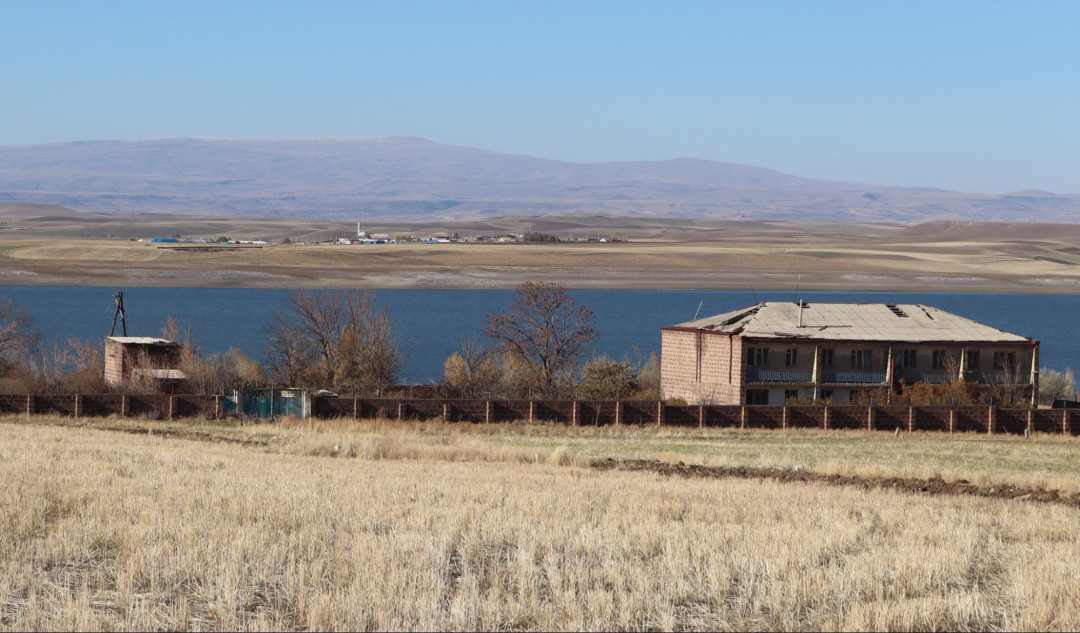
By Martina Sanna
The Akhuryan Reservoir stands along the Armenia-Turkey closed border. From the Armenian side, a mosque is visible just beyond the water, surrounded by what looks like a gathering of small villages on the Turkish side. The mosque clearly shows that water is not the only thing dividing the land.
An inter-state agreement has been in place for more than 60 years to ensure that the water resources from Akhuryan are distributed equally between Turkey and Armenia. Yet, even if a consensus on water distribution is in place, important issues such as water quality remain unresolved.
A water quality problem
The Akhuryan-Arpaçai reservoir was built under a USSR-Turkey interstate agreement signed in 1963, with the aim of building a dam on Akhuryan river and redirecting the water from four different rivers into a common basin for irrigation. Following Armenia’s independence from the Soviet Union in 1991, the reservoir kept operating under the same 1963 agreement, establishing an equal distribution of water resources.
But according to the villagers who use Akhuryan’s reservoir irrigation system, the issue is not the amount of water they receive, but its quality.
Garabet Kazanjian, a professor and researcher at the Acopian Center for the Environment at the American University of Armenia, says the issue has been raised to the government officials several times in the past years.
“We talked to communities near the Akhuryan river, a lot of the sewage from these towns and cities are dumped in the river without proper treatment. They always complain that the water smells bad,” Kazanjian tells Civilnet. “It is not much talked about, but besides quantity we have a lot of troubles related to water quality.”
In a 2009 report by the Institute of War and Peace, researchers warned of heavy metals and toxic materials found in the basin.
Those materials, called “persistent pollutants,” don’t get decomposed over time by the bacteria in the water like organic pollutants. They stay there and, if this water is used for irrigation, they end up contaminating the soil and everything that’s grown on it. Depending on the kind of pollutant and its concentration, this can lead to serious health issues.
The authors of the study also argued that without cooperation between Armenian and Turkish ecologists, no actions could be foreseen to improve water quality as each side has no available data on the kind of pollutants the water from the other side might be subject to.
In addition, even if such a cooperation was in place, Kazanjian argues that no in-depth analysis of the water is currently carried out at institutional level, as there are no norms or required standards for irrigation water in Armenia.
“The different government bodies and entities are very hesitant to introduce this,” Kazanjian tells Civilnet. “The government has not yet built the infrastructure with sewage water treatment plants, so there is no infrastructure to support this kind of law.”
A need for renovation
Aside from the pollution issue, in recent years experts have warned about an increased shortage of the available water in the Akhuryan basin. According to Kazanjian, this could have side effects on water quality, due to an intensified concentration of pollutants.
One of the three main causes identified is the deteriorating infrastructures of the basin, to the point that several previously served districts have been completely cut out from the reservoir’s reach.
An example of this can be seen in some of the villages in the Shirak region where in the Soviet Union, a plant was in place to pump water up the hills to irrigate the area.
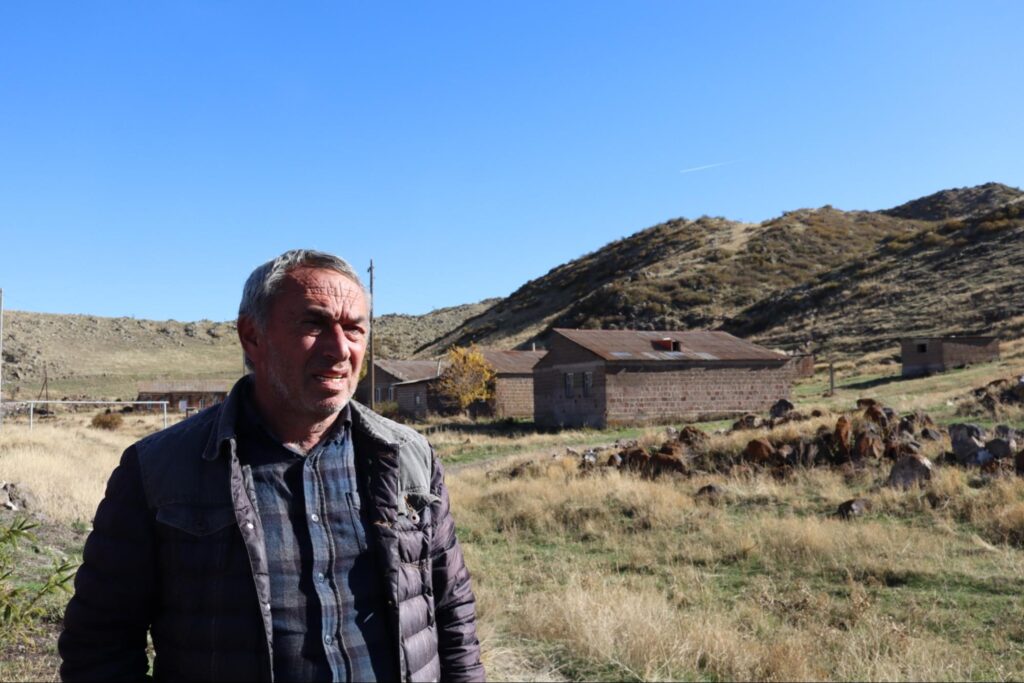
“After the fall of the Soviet Union, people from the villages tore apart every structure that was left from Soviet times, buildings, warehouses, even irrigation pipes,” says Vahan Tumasyan, a resident of Bagravan village in Shirak province, less than 10 km from the Akhuryan reservoir.
Like several other villagers, Tumasyan keeps cultivating wheat and parsley on his land using his drinking water and occasional rain for irrigation.
“If the Soviet Union had not collapsed, you would be now sitting in a big forest,” he jokes.
Professor Kazanjian argues that the need for the Akhuryan reservoir to have proper self-cleaning filters to absorb or remove excess traces of heavy metals is the most critical problem.
“The water isn’t treated in any sense,” he tells CivilNet. “If we find inorganic pollution from industries, from Gyumri, if there are acid salts, heavy metals and so on, this is problematic for irrigation use.”
Kazanjian also mentions that water quality standards are included in the Comprehensive and Enhanced Partnership Agreement (CEPA) that Armenia stipulated with the European Union in 2021. In this agreement, Armenia committed to develop financing strategies for investments in infrastructure and technology related to water quality and resource management.
“Unfortunately, I have not seen very concrete steps toward this,” says Kazanjian. “These things take years to be in place. It’s not just building a wastewater treatment plant, you need to bring in the expertise and train people. They need to start now, we are already late.”




 Stories