 Civilnet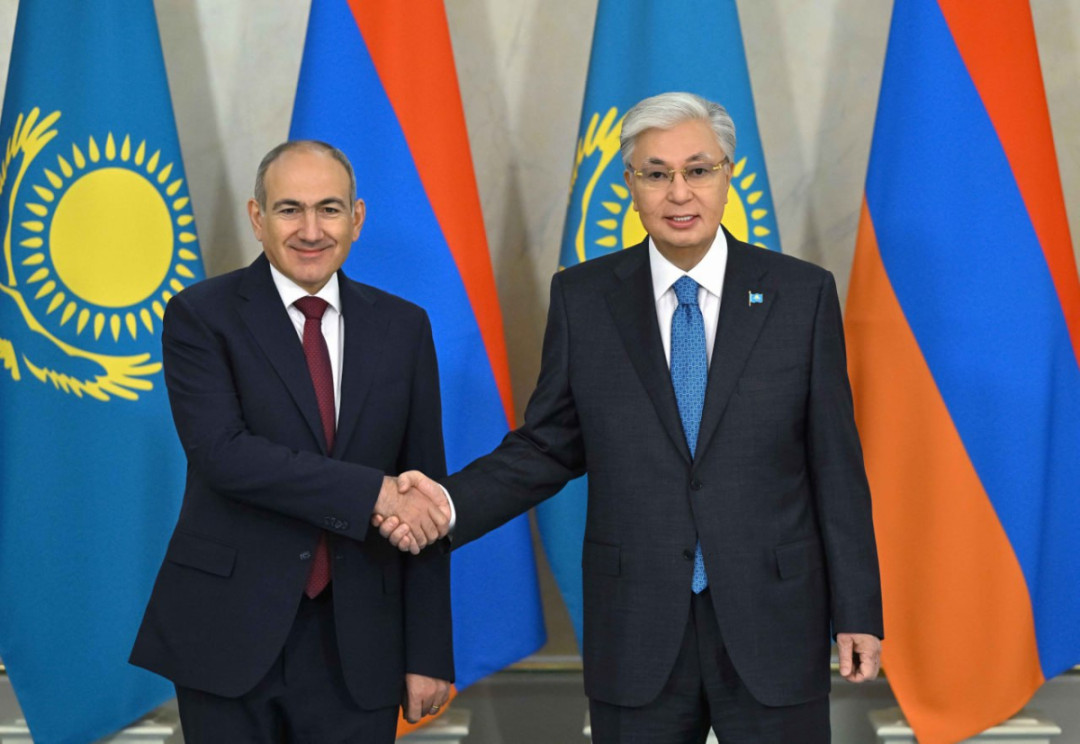
By Arshaluis Mgdesyan
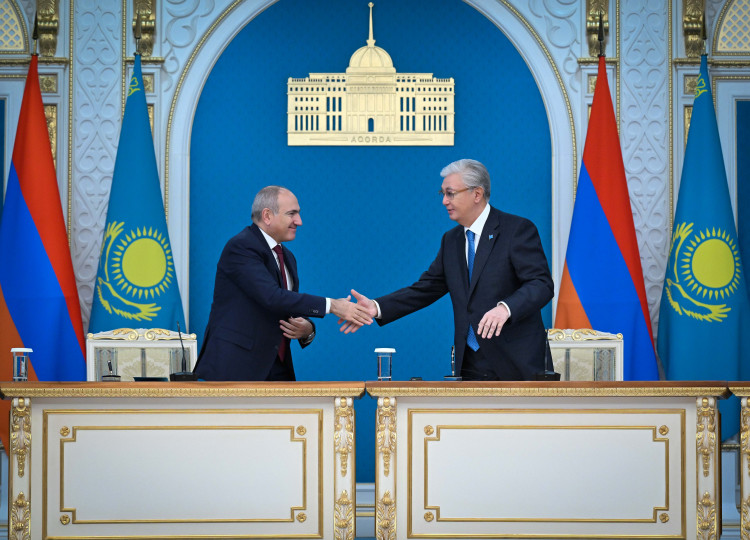
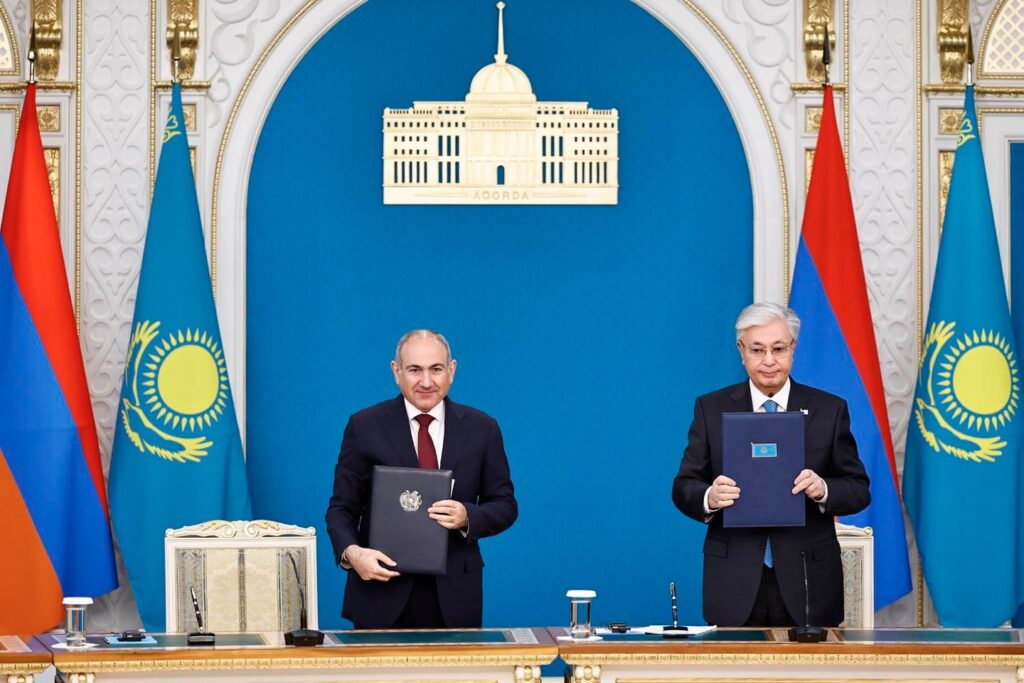
Armenia and Kazakhstan have agreed to elevate their bilateral relations to the level of a strategic partnership. The corresponding declaration was signed following talks between the leaders of the two countries Thursday in Astana. The key outcome of the meeting was an agreement to begin transit shipments of Kazakh cargo to Armenia through Azerbaijan, signaling a breakthrough in unblocking regional logistics.
Prime Minister Nikol Pashinyan’s visit to Kazakhstan on November 20–21, during which he received the country’s highest state award, concluded with the signing of a package of agreements covering trade, digitalization, and the transport sector.
Political Support and Award Ceremony
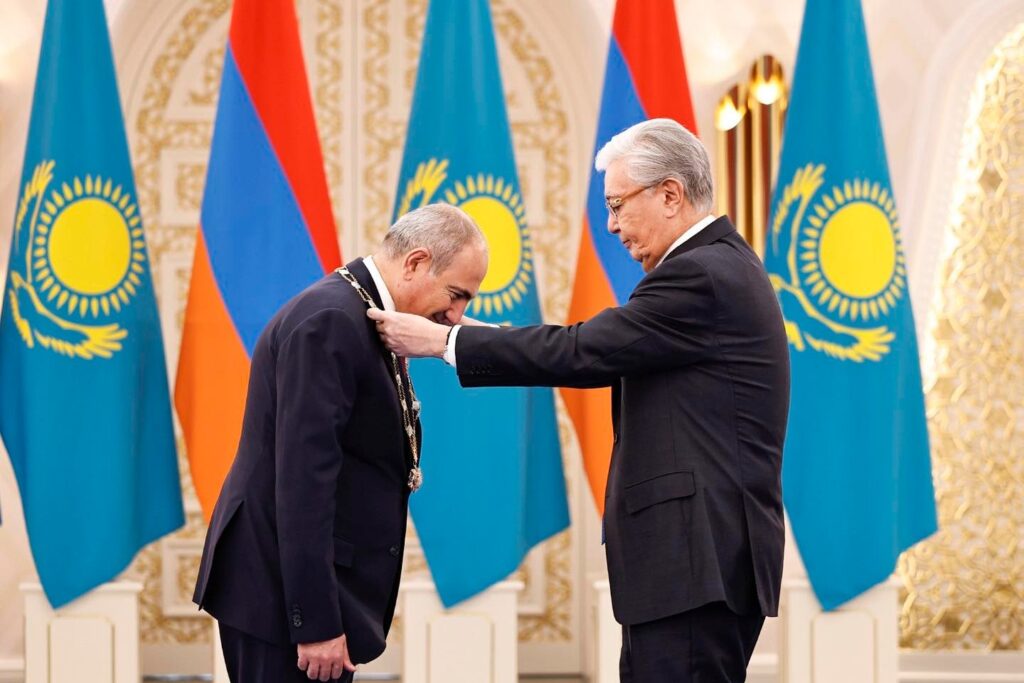
During a ceremony at the Ak Orda Presidential Palace, President Kassym-Jomart Tokayev presented the Armenian prime minister with the Order of “Altyn Qyran” (Golden Eagle). Tokayev described Pashinyan as a leader “capable of making bold, unconventional decisions” amid a complex geopolitical environment.
Tokayev highlighted Yerevan’s role in the South Caucasus peace process, referring to the signing of a joint document by the leaders of Armenia, Azerbaijan, and the United States in Washington.
“Friendly Armenia has chosen the path of peaceful, sustainable development, a choice in which you have played a historic role,” Tokayev said, emphasizing Kazakhstan’s support for Armenia’s sovereignty and foreign policy.
Pashinyan, in turn, called the award a sign of respect for the Armenian people and praised Tokayev’s diplomatic authority in the region.
A Logistics Breakthrough: The Azerbaijan Factor
The most significant economic development was the agreement on new transport routes. Tokayev announced Kazakhstan’s support for Armenia’s “Crossroads of Peace” initiative, which is aimed at unblocking North–South and East–West communications, and said Astana intends to integrate it with the Trans-Caspian International Transport Route linking China, Kazakhstan, the Caspian Sea, Azerbaijan, Georgia, and Europe.
The two sides also officially confirmed that transit through Azerbaijan is now operational - a notable development given that Armenia and Azerbaijan continue working toward normalization.
“I express my gratitude to the leader of Azerbaijan for lifting sanctions and creating conditions for direct bilateral trade through his country. In November of this year, the first shipment of Kazakh wheat, 1,000 tons, reached Armenia via Azerbaijan,” Tokayev said.
Astana also announced its readiness to increase exports to Armenia across seventy product categories worth $350 million and said direct flights would be launched soon.
Still, despite both countries being members of the Eurasian Economic Union, their bilateral trade remains small. From January to September 2025, trade turnover amounted to just $59 million according to Armstat, Armenia’s statistical committee, a mere 0.4% of Armenia’s total foreign trade, and even declined compared to the same period in 2024.
Technology and Overcoming the Legacy of 2016
Education and technology cooperation were also in focus. Armenia will share its experience in developing creative technology education centers: next year, a TUMO Astana school is planned to open at the Kazakh Alem.ai center. TUMO is Armenia’s innovative educational program for teenagers aged 12–18, focused on technology and design.
A ceremony was also held in Astana to inaugurate a street named after Mesrop Mashtots, the creator of the Armenian alphabet.
The gesture closes the chapter of tensions from 2016 when, amid the escalation in Nagorno-Karabakh and Kazakhstan’s refusal to hold a planned EAEU summit in Yerevan, a crisis of trust emerged. Public anger in Armenia led to protests, including the removal of street signs named after Kazakhstan’s first president, Nursultan Nazarbayev, in the village of Arich in Shirak province.
The new ceremony fulfills “mirror” agreements reached during Tokayev’s visit to Armenia on April 15, 2024. As part of strengthening the twin-city relationship between Astana and Yerevan, the sides agreed to exchange cultural gestures. The first step was the opening of a park in Yerevan named after Kazakh thinker Abai Qunanbaiuly in April 2025. The inauguration of Mashtots Street in Kazakhstan’s capital completes this symbolic exchange.
View from Yerevan: Balancing Kazakhstan’s “Special Relationship” with Baku
Armenian political analyst Sergey Minasyan notes that Kazakhstan’s current rapprochement with Yerevan fits into Astana’s traditional strategy of maintaining regional balance. According to the expert, despite Kazakhstan’s “special relationship” with Azerbaijan, which is shaped by Turkic ties and geography, Astana seeks to offset this tilt by building balanced relations with Armenia.
“Kazakhstan and Armenia have long-standing, historical, and pragmatic relations. Plus, the two countries often share similar positions within the Eurasian Economic Union,” Minasyan told CivilNet.
He added that Central Asian states, especially Kazakhstan, have a pragmatic interest in opening new transit routes through Armenia. Any opportunity for regional unblocking, as promoted by the Armenian government, holds added value for Kazakhstan as a means of diversifying routes, and for Armenia, as an added source of strategic relevance.
“The fact that the president of Kazakhstan presented Armenia’s prime minister with the country’s highest state award confirms the course toward strategic cooperation,” the analyst concluded.
View from Astana: New Horizons in Strategic Planning
Meanwhile, Kairbolat Sakhmetov, president of the Astana Diplomatic Club, considers Nikol Pashinyan’s official visit both important and timely, aimed at strengthening bilateral relations. He emphasized that as economic ties between Astana and Yerevan intensify, new horizons for strategic planning are emerging, especially in the logistics sector.
“A special synergy can be achieved by combining Kazakhstan’s transit potential with Armenia’s ‘Crossroads of Peace’ initiative, whose implementation could give an additional boost to regional trade,” Sakhmetov told CivilNet.
Beyond transport corridors, he highlighted the importance of humanitarian and technological cooperation. He pointed to the growing potential for sharing experience in the IT sector and artificial intelligence, recalling the successful launch in Kazakhstan of a creative technology center modeled on Armenia’s TUMO program.
Sakhmetov also stressed the need to develop tourism clusters, noting that high demand for travel and genuine cultural exchange is currently hindered only by the absence of direct flights, whose launch would be a logical next step following the successful negotiations.
TAGS: Pashinyan Kazakhstan visit, Armenia Kazakhstan relations, Astana Yerevan cooperation, strategic partnership Armenia Kazakhstan, Kazakh transit to Armenia, Crossroads of Peace initiative, Mashtots street Astana, TUMO Astana, Armenia Azerbaijan peace process, Tokayev Pashinyan meeting, Kazakhstan Armenia trade, Armenia foreign policy.




 Stories