 Civilnet
By Lia Avagyan
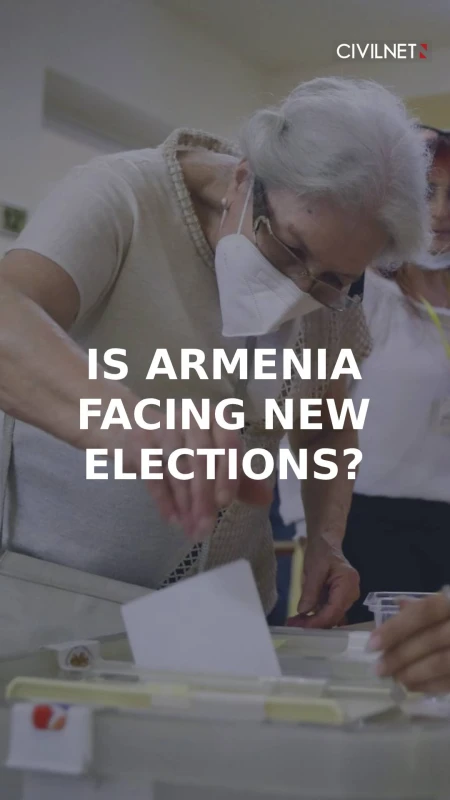
Armenia’s next parliamentary elections, scheduled for June 2026, will take place against a backdrop of growing internal vulnerabilities and external pressures that could test the country’s democratic resilience, according to a new risk assessment by the Yerevan–based Center for Culture and Civilization Studies.
The report notes that while reforms to Armenia’s electoral system have largely eliminated the risk of ballot stuffing on election day, the integrity of elections extends far beyond what ends up in the ballot box. Independent observers have repeatedly raised concerns about the misuse of administrative resources, opaque campaign practices, post-election legal maneuvering that can effectively alter outcomes, and the spread of disinformation and hate speech during campaigns.
“These risks will be particularly critical during parliamentary elections,” the authors warn, stressing that countering them will depend heavily on the role of independent media, civil society and active citizen oversight.
The report also briefly flags persistent problems with political party financing. While Armenia has a formal legal framework for campaign finance, enforcement remains weak and reporting is often delayed until well after elections, limiting meaningful public scrutiny. Recent investigations by journalists have highlighted how gaps in oversight allow large donations and complex funding schemes to escape timely accountability, reinforcing concerns that financial opacity can distort the electoral playing field without directly violating election-day procedures.
Also read: Illicit Party Financing: How Civil Contract Circumvents the Law Without Consequences
Beyond domestic governance issues, the report emphasizes hybrid threats, which it describes as one of the main dangers facing Armenia in the election year. These include coordinated information operations, cyberattacks, and financial influence aimed at shaping political outcomes without overt military confrontation. The report warns that parliamentary elections are likely to be a prime target for such operations, with disinformation campaigns designed to deepen polarization, spread fear, and undermine trust in institutions.
According to the authors, Armenia’s vulnerability to hybrid threats is closely linked to internal polarization and weak public trust. A divided society, they argue, creates fertile ground for external actors seeking to manipulate democratic processes. Strengthening governance, institutional credibility, and media independence is therefore presented as the most effective long-term defense.
External risks
External risks add another layer of uncertainty to the electoral environment. The report highlights the prolonged instability in Iran as a significant concern, noting that further internal unrest or external military escalation could have direct economic, security, and humanitarian spillover effects for Armenia, including pressure on borders and trade routes.
Relations with Azerbaijan and Turkey also remain a key source of risk. Despite the initialing of a peace agreement between Yerevan and Baku in 2025, the report warns that Azerbaijan’s continued maximalist rhetoric and demands could escalate tensions, particularly if political developments in Armenia are framed externally as signs of weakness or revanchism. At the same time, the slow pace of normalization with Turkey is seen as perpetuating Armenia’s regional isolation, with implications for both security and economic stability during a sensitive political period.
Taken together, the report concludes, Armenia’s elections will be shaped not only by technical electoral procedures but by a broader ecosystem of political trust, institutional strength and regional volatility. Without sustained efforts to address governance shortcomings and societal polarization, the authors caution that elections risk becoming a focal point for both internal erosion and external interference, even if the act of voting itself remains largely secure.

 Stories