 Civilnet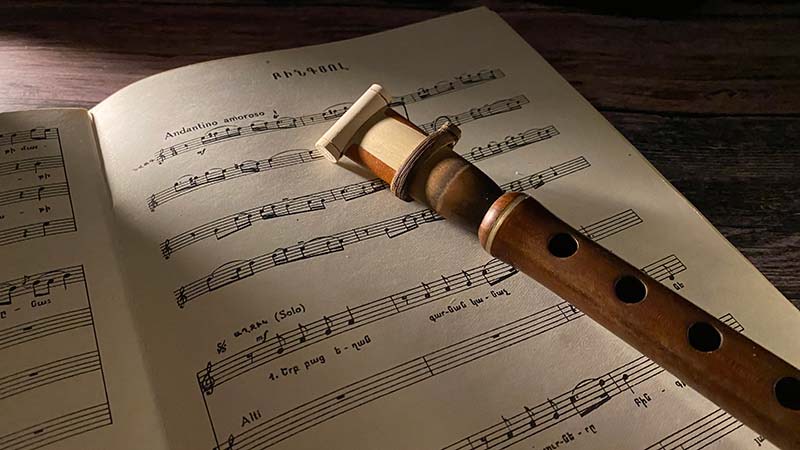
By Olivia Mouradian
From Armenian king Tigran the Great’s court to showings of The Last Temptation of Christ or Gladiator, the duduk has mesmerized audiences spanning both time and geography. As is the case with most instruments in Western Asian music, multiple countries have their own variations of the duduk. However, this instrument is woven through Armenian history and life in a distinct way. Its haunting sound remains a key aspect of Armenian musical tradition, with UNESCO recognizing the duduk and its music on its Representative List of the Intangible Heritage of Humanity in 2008.
The duduk has remained throughout religious, political, and geographic changes in Armenia. While the duduk is storied in pre-Christian Armenian mythology, it appeared in historical records for the first time in the fifth century. The instrument was originally called tsiranapogh (ծիրանափող; meaning apricot-wood flute). “Duduk”, a more simple term, became the standardized name in 1920 during the early Soviet era.
Although its name and tuning techniques have changed with time and technology, it still maintains the same general shape from over a thousand years ago. With only ten holes, the duduk is deceptively simple. However, it’s a challenging instrument to master. Beyond the necessity of the instrument being properly tuned, there’s still the chance that a player will not be able to play in tune with the tiny aperture created by the double reed.
“To produce the sound that enchants everyone, it takes years of experience,” said Armen Matosyan, founder of Canada-based duduk retailer and publisher Dudukhouse.
Structurally, the duduk has two main parts: the body and the reed. Typically, constructing the body and constructing the reed are two different artisanal processes. The Armenian instrument is set apart in its composition — as its body is made of wood sourced from apricot trees in the Ararat Valley in Armenia. Other countries, such as Georgia and Azerbaijan, have also used wood from walnut and plum trees for the body.
The duduk’s reed is made of reed cane, a material which was affected by the 2023 war between Armenia and Azerbaijan. Traditionally, the reed cane of the duduk was sourced from the Arax River basin in and around Artsakh, or Nagorno-Karabakh. Now that Artsakh is under Azerbaijani control, the reed cane for this ancient instrument is being sourced elsewhere.
When discussing these changes with Matosyan, he has not seen and does not anticipate manufacturing issues even with these changes in sourcing. Although the sound changes with the reed, there’s not been a discernible change in quality now that reeds are being sourced from other countries. He said that reeds are very personal to the player, meaning that the quality of sound is most prominently reliant on the player’s technique and skill.
Completely out of the music world at the time, Matosyan started playing the duduk when he was in his forties. He had moved from Yerevan to Toronto with a duduk as a souvenir, and found himself wanting to learn how to play. He found a teacher while on vacation in Armenia, and ended up being introduced to duduk master Georgy Minasov. He spent his remaining two weeks of vacation learning how to learn sheet music. Just as methods of tuning have evolved with technology, so have the methods by which people learn to play the duduk. Following his trip to Armenia, he continued to learn from Canada on Skype.
Back in Canada, he noticed a gap in the market. While there were plenty of places to purchase high-quality duduks in Armenia, he saw that the options available on Amazon to audiences in North America were generally not maintaining the same level of tuning and quality that he saw in Armenia. That is why he started Dudukhouse, which provides not only high-quality duduks but also instructional materials to assist players in developing their practice.
As playing the duduk has historically been an oral tradition, there are additional barriers to entry for people who want to learn how to play outside of Armenia. Seeing a scarcity of written instructional materials, Matosyan published a beginner’s guide to playing the duduk in December. In creating this guide, he wanted to include additional context and explanations of foundational topics to encourage new players. This book is one of 15 titles dedicated to the duduk and Armenian heritage that Dudukhouse has published.
Matosyan has received an international response to Dudukhouse, with 98% of customers coming from outside Armenia. While their consumers are of all age ranges and levels of musical background, he said, “The story is the same: They’ve heard the sound, they fell in love, and they want to learn.”
The connection many Armenians have with the duduk is beyond purely historical or geographical. For Matosyan, he sees the duduk as being a part of the DNA of the Armenian people. He says that an Armenian is often able to pick the instrument out of even the most involved of musical compositions. What stands out about the Armenian duduk to Matosyan is the performance technique and sound quality, both of which he accredited as being the most advanced out of the variations of duduks.
The practices of constructing and playing the duduk continue to evolve with the changes of the world around them. While the source materials and methods may change, its emblematic sound remains. As Armenian artisans and musicians — both in Armenia and in the diaspora — carry on this tradition, with it they also carry the history and resilience of the land it was born out of.





 Stories