By Siranush Adamyan
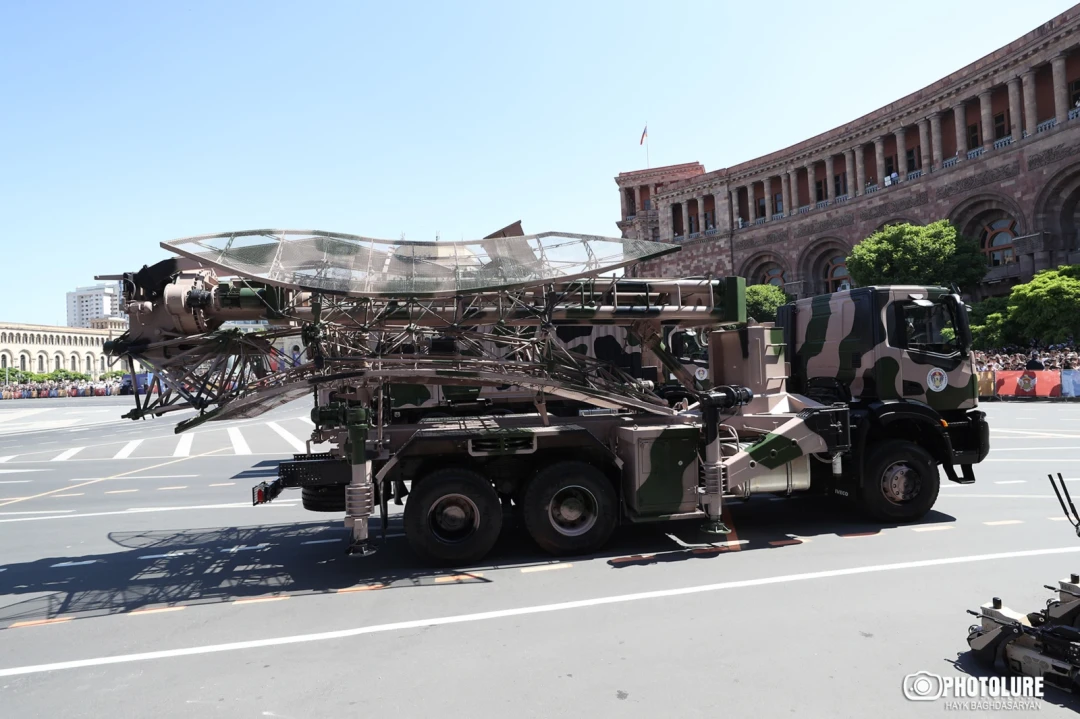
Armenia held a large military parade in Yerevan on May 28, the Republic Day, showcasing newly acquired weapons systems from a range of foreign suppliers as well as domestically produced military equipment.
The parade took place just ten days before Armenia’s June 7 parliamentary election and has been widely viewed by political observers as part of the government’s pre-election messaging. Unlike previous large-scale military parades, which were traditionally held on September 21 to mark Armenia’s Independence Day, this year’s event was held on Republic Day and took place amid an active election campaign.
Prime Minister Nikol Pashinyan’s government has increasingly highlighted defense reforms and military modernization as it seeks to rebuild Armenia’s armed forces following the country’s defeat in the 2020 war with Azerbaijan.
The parade offered one of the clearest public demonstrations yet of Armenia’s efforts to diversify its arms suppliers away from its longstanding dependence on Russia.
Armenia has nearly tripled its military spending in recent years and launched an extensive rearmament program after 2022. While Russia had historically been Armenia’s dominant arms supplier, Yerevan has since expanded military cooperation with partners in Asia, Europe, and the Middle East.
Several systems displayed during the parade had already been publicly reported, including equipment acquired from India and France. However, the event also revealed a number of weapons systems whose delivery had not previously been announced.
Among the most notable were Chinese-made CH-4B armed drones, presented under the Armenian name Aghegh (Arrow), GAM-120LR anti-tank missiles named Nizak (Spear), and ASN-301 loitering munitions designed to target enemy radar installations and air defense systems.
The parade also featured Iran’s AD-08 air-defense system, displayed under the Armenian name Karich (Scorpion). The system appeared alongside a radar configuration that differed from standard publicly known versions of the AD-08. Military analysts noted the presence of what appeared to be an Iranian-made low-altitude surveillance radar.
The display highlighted the growing role of Chinese and Iranian military technology in Armenia’s defense procurement strategy. Both systems have seen operational use abroad. CH-4B drones have been employed in conflicts in Iraq and Yemen, while Iranian air-defense systems have recently been tested under conditions of intensive aerial attacks.
Another noteworthy aspect of the parade was the presence of several Russian-made weapons systems, including the Tor-M2KM air-defense system, Kornet-M anti-tank missiles, and TOS-1A multiple launch rocket systems.
According to military analyst Eduard Arakelyan of the Regional Center for Security and Democracy, the appearance of these systems may indicate that at least some Russian weapons deliveries that had been delayed after 2022 were eventually transferred to Armenia despite the deterioration of military-technical cooperation between Moscow and Yerevan.
The Armenian defense industry was also represented. The parade included a wide range of domestically produced unmanned vehicles, from small loitering munitions and tactical drones to larger strike drones and jet-powered unmanned platforms.
Armenian defense companies have expanded rapidly after the 2020 war, although analysts caution that the effectiveness of many newly developed systems can only be assessed through use in actual combat. Questions remain about their scalability, production capacity and ability to keep pace with rapidly evolving battlefield technologies.



 Stories