 Ani Grigoryan
 CivilNetCheck
Ani Grigoryan, Victoria Olari, Sopho Gelava, Givi Gigitashvili, and Salome Tsetskhladze
In the run-up to Armenia’s June 7 parliamentary elections, the Russian organization the Evrazia Foundation has continued to operate freely in the country, despite being under U.S., EU, and UK sanctions and having a history of interfering in electoral processes.
Operating under the guise of humanitarian programs and educational initiatives, Evrazia positions itself abroad as a tool of Kremlin influence.
The organization runs media schools, camps, forums, and social assistance programs, yet in various countries its activities have been linked to influencing electoral processes, covert fundraising, and destabilizing actions directed against democratic institutions.
This joint investigation by CivilNet and DFRLab shows how, ahead of parliamentary elections, Evrazia is replicating in Armenia the model of electoral interference it employed in Moldova.
In cooperation with a representative of a pro-Russian political force in Armenia, Evrazia launched an online petition platform aimed at rallying Armenians around a religious issue, while also including political and electoral demands in the petition. It has not been possible to independently verify the authenticity of the number of signatories claimed by the platform.
Through its platform, Evrazia also organizes gatherings near Armenian churches in Armenia and abroad. In addition, the organization’s representatives have openly offered to pay for plane tickets for Armenians living in Russia to bring them to Armenia and ensure their participation in the elections, repeating the tactic used in Moldova ahead of the 2024 elections.
In September 2024, the U.S. Department of the Treasury’s Office of Foreign Assets Control (OFAC) added Evrazia to the Specially Designated Nationals (SDN) list, citing the organization’s participation in “Russia’s covert global influence operations.”
In October 2024, the European Union imposed sanctions on Evrazia for actions aimed at destabilizing Moldova. In April 2025, the United Kingdom took the same step for acting on behalf of sanctioned Moldovan oligarch Ilan Shor.
An NGO in name, an instrument of influence in essence
Evrazia carries out cultural, educational, and professional programs in countries that Moscow considers its “near abroad.” These include youth programs, teacher training, journalism grants, business missions, and cultural projects, serving as tools of Russian soft power.
The organization openly presents itself as a counterweight to Western initiatives- USAID (USAID), the Konrad Adenauer Foundation, and the Open Society Foundations. At the “Evrazia: A Territory of Traditional Values“ conference held in Moscow in April 2026, Russian Foreign Ministry spokesperson Maria Zakharova said that over its two years of activity, the organization had mobilized 120,000 participants in forty countries.
Evrazia opened an Armenian branch in June 2024. It supports eleven Russian-language centers operating in Yerevan and offers courses in robotics, animation, and financial literacy. The organization also launched a media school whose lecturers include figures linked to the Russian state propaganda machine. It also organizes cultural trips and, within these programs, sends young people to the “Artek” camp in Crimea. Initiatives include competitions on Russian history and performances about World War II, aligned with Kremlin narratives.
In Moldova, security services viewed similar programs as part of Evrazia’s influence infrastructure, through which the organization built networks for voter mobilization, influence, and disinformation.
How Evrazia builds political influence through aid
Humanitarian aid has been one of Evrazia’s most consistent tools in both Moldova and in Armenia.
In Moldova, Evrazia supplied the autonomous region of Gagauzia with fuel, fertilizer, and grain in volumes that raised suspicions of corruption. The organization also made cash payments to around 30,000 pensioners and offered to cover railway workers’ wages.
Moldovan authorities concluded that these payments were not humanitarian aid but a vote-buying scheme aimed at influencing the presidential election and the EU accession referendum scheduled for October 2024.
The U.S. Treasury Department also noted this, stating that the funds were intended for a vote-buying campaign in favor of pro-Kremlin candidates. The UK Foreign Office described it as an attempt to bribe citizens to secure a “no” vote in the EU accession referendum.
In response, Moldovan authorities blocked financial flows linked to Evrazia and designated the organization a national security threat.
In Armenia, Evrazia has been implementing humanitarian programs since August 2025, primarily targeting those forcibly displaced from Nagorno-Karabakh. The organization claims it supplied 180 tons of food and essential goods to 10,000 families in 45 settlements. It also launched the helpartsakh.ru platform (as of June 5, 2026, the website is unavailable), where, according to claims, 6,000 families displaced from Nagorno-Karabakh registered to receive assistance.
The campaign began in early August 2025, and by the end of that year, Evrazia council member Mika Badalyan said that applications had closed and around 800 applications had been successfully verified, after which those families were to receive aid.
About the launched platform
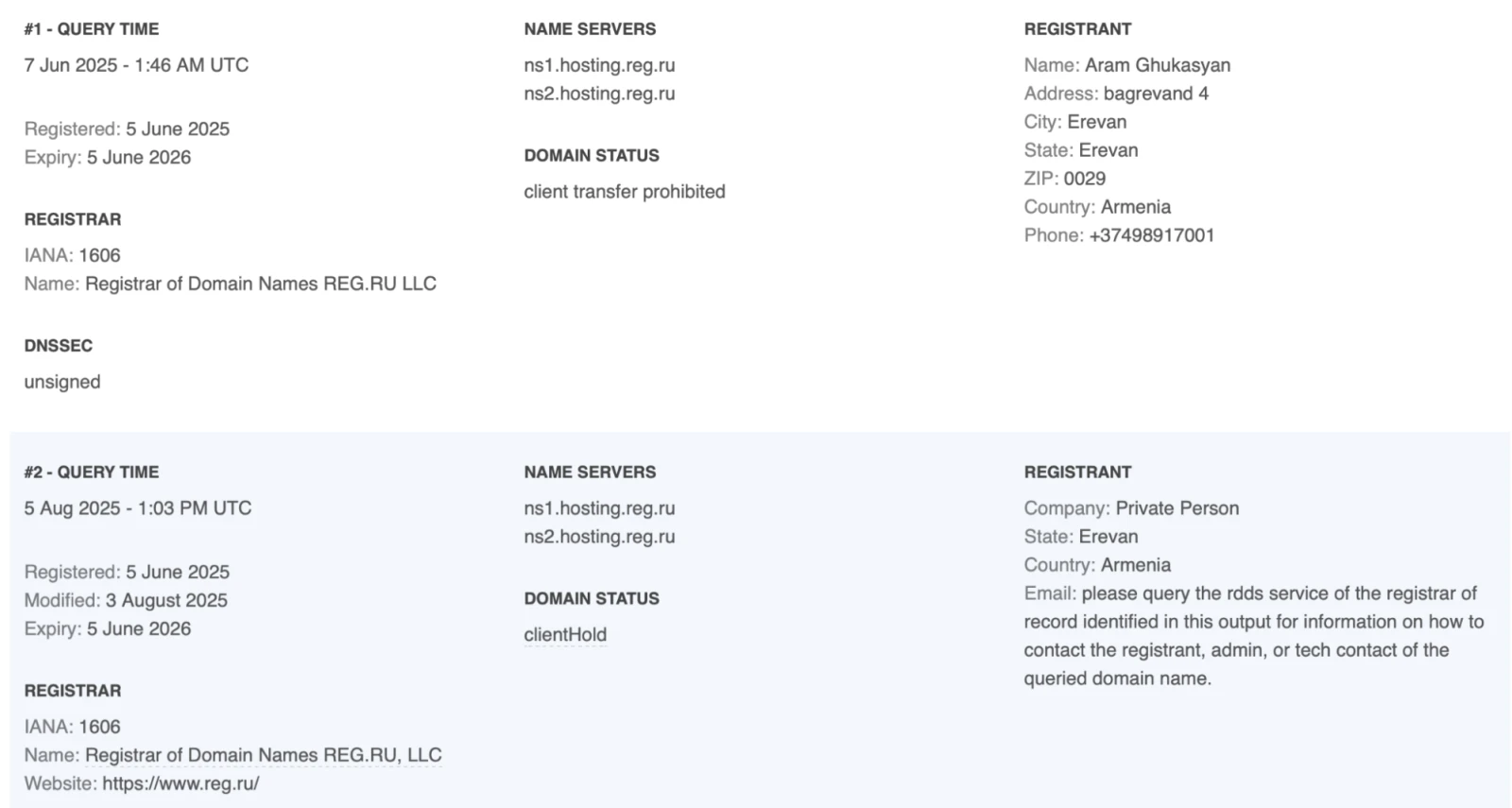
Although Evrazia announced the launch of the helpartsakh.ru platform on August 4, 2025, the domain had been registered two months earlier on June 5 via the Russian service REG.RU, indicating prior preparations. Registrant information is protected by a privacy service. However, on the same day, an almost identical helpartsakh.online domain was also registered using the same server. Its WHOIS data listed Aram Ghukasyan as the owner, with a Yerevan address and an Armenian phone number.
One day before the public launch of the campaign, on August 3, 2025, helpartsakh.online’s registration was updated, and the named owner’s details were replaced with a privacy protection service. This may indicate an attempt to conceal the owner’s identity before the campaign’s launch.
We also identified a Facebook account under the name Aram Ghukasyan which, according to our research, is a member of the Evrazia team.
Armenian authorities have seen risks of electoral interference in “Evrazia’s” humanitarian activity. In March 2026, Maria Zakharova said the Armenian government blocked a humanitarian aid shipment planned by Evrazia, citing provisions of Armenian law that restrict charitable donations and the provision of aid during the pre-election period.
Under the current Armenian Electoral Code, candidates and parties participating in elections are prohibited during the campaign period and on voting day from providing or promising voters money, food, goods, or services free of charge or on preferential terms. This prohibition also applies to charitable organizations whose names may be linked to or resemble the names of political forces or candidates participating in the elections. Zakharova claimed that Yerevan’s decision not to allow the delivery of “purely charitable humanitarian aid” was driven by the authorities’ pre-election desire to “erase any mention of Russia.”
Notably, in some cases Evrazia’s aid was distributed in the offices (1, 2, 3) of the opposition “Hayots Hayrenik” (Armenian Homeland) party. The party is led by former National Security Service director Arthur Vanetsyan, who in recent years has been actively involved in opposition political activity.
Although the party is not participating in the current parliamentary elections, Vanetsyan is known for his pro-Russian statements. In particular, in 2021, answering Russian host Vladimir Solovyov’s question, “Who does Crimea belong to?”, he responded: “Crimea is ours.”
Clergy and religious infrastructure as a tool of Evrazia’s interference
In August and September 2024, around 900 Moldovan clergy and associated parishioners took part in Russian-funded “pilgrimages” to Moscow. According to Moldovan security services, upon arrival in Moscow participants were offered contracts worth $300 to $1,000, as well as bank cards of Russia’s “Mir” payment system. According to Jurnal.md, to receive these payments, clergy had to sign cooperation contracts with Evrazia, under which they were registered as the organization’s official partners.
Those financial incentives appear to have been linked to the expected role of clergy in shaping political sentiments in rural communities and religious circles, particularly to mobilize sentiment against Moldova’s EU accession referendum and the country’s pro-European leadership.
One of the clearest examples of how Evrazia is reproducing in Armenia the mechanisms used in Moldova is the armspyurk.com platform, launched in late January 2026 and promoted on February 11 on Mika Badalyan’s Telegram channel, head of Evrazia’s Armenian branch.
The website presents itself as a civic initiative aimed at defending the Armenian Apostolic Church. Although the platform lists a Yerevan address, it is hosted on Russian servers. Moreover, according to the site’s privacy policy, users’ personal data are processed in accordance with Russian Federation law by Vahe Avetyan, a Russian citizen residing in St. Petersburg.
The website states in particular: “The personal data operator is Avetyan Vahe Egorovich, residing in the Russian Federation, in the city of St. Petersburg. Contact email address: [email protected].”
On his Facebook page, Avetyan shared the link to a Telegram group created for signatories of the armspyurk.com petition. There he also posts AI-generated videos promoting the “Strong Armenia” party.
In one of the videos posted on Facebook, Avetyan says: “On February 12 we will learn who the prime ministerial candidate of our ‘Strong Armenia’ party is,” indicating his connection to the “Strong Armenia” party.
In a Telegram post published on March 17, Mika Badalyan calls armspyurk.com “our initiative”, and in another interview states: “We launched the signature-collection initiative.” These statements suggest that armspyurk.com may be a joint initiative involving Evrazia and individuals linked to the pro-Russian “Strong Armenia” party.
Although the demands in the petition published by armspyurk.com mostly concern the church, they also include a demand to “ensure honest and transparent elections.” On the website’s homepage, five people are presented as “prisoners of conscience,” four of them clergy, and the fifth a Russian-Armenian businessman Samvel Karapetyan, leader of the opposition “Strong Armenia” alliance.
As of March 2026, armspyurk.com had turned into a full-fledged political news platform, publishing daily materials about the elections and anti-European commentary. On March 13, Badalyan announced that armspyurk.com had been significantly updated and was now “not only a signature-collection platform, but also a full-fledged information resource covering events related to the Armenian Apostolic Church.” From that point, the number of registered signatories on the platform sharply increased. On March 17, Badalyan said the initiative had received “the support of one of our compatriots,” thanks to which, he claimed, armspyurk.com would receive “substantially broader coverage.”
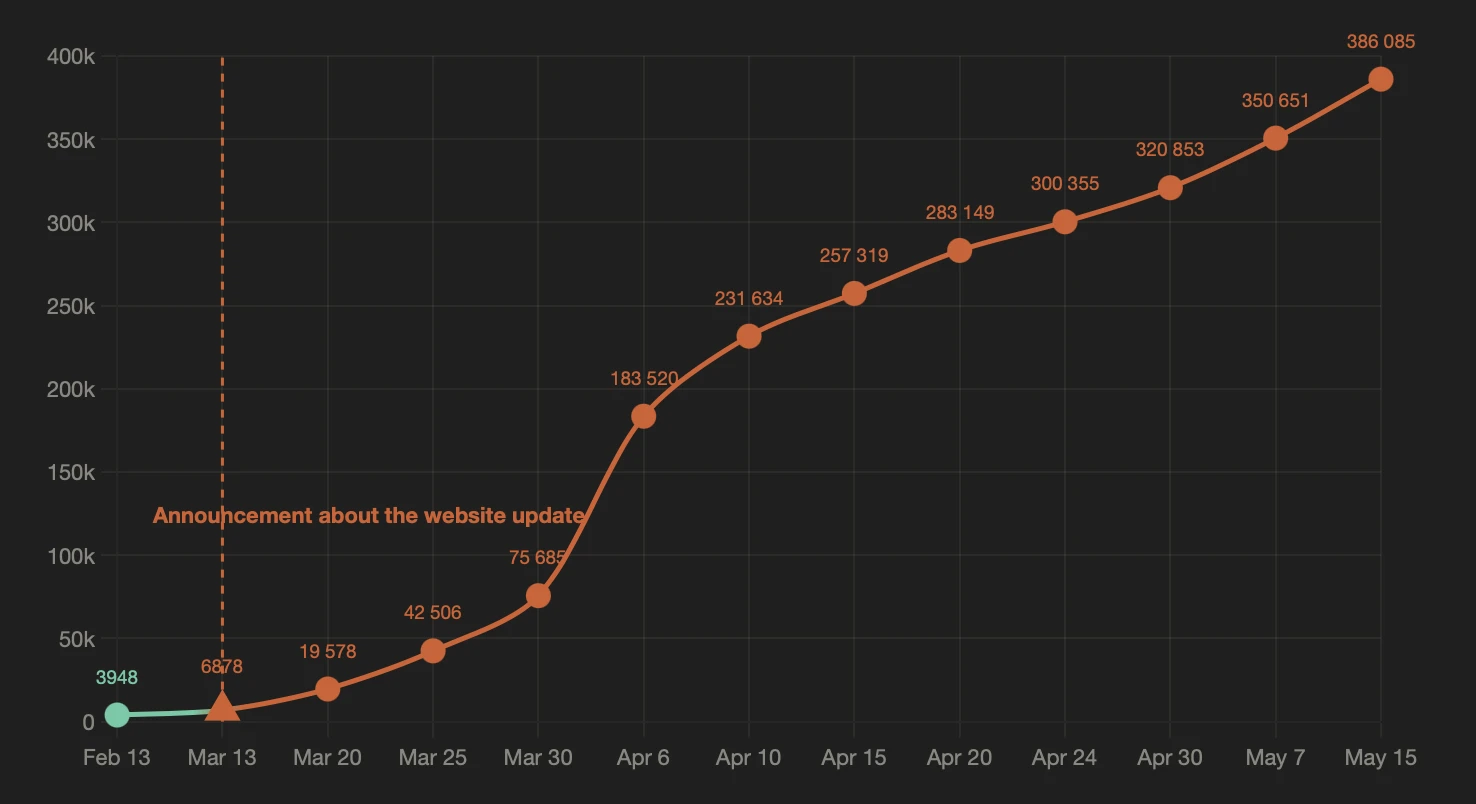
After March 13, the dynamics of the growth in signatures registered on armspyurk.com raise questions about their credibility. In the first month after the site’s launch, from February 13 to March 13, 2026, only 2,930 signatories joined the petition. But in the next month, from March 13 to April 10, an additional 224,756 signatures were added, 77 times more than in the previous period. The surge coincided with Badalyan’s announcements about the website update and support from an unknown sponsor.
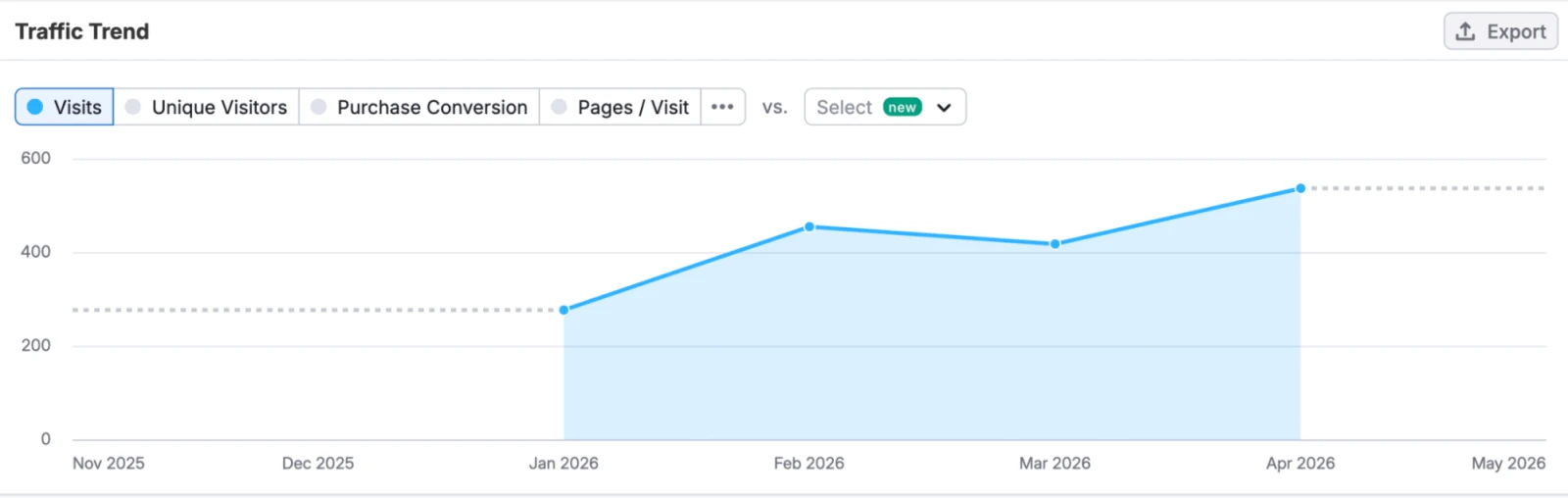
We examined visit statistics for armspyurk.com and found that in March, April, and May 2026 the site had only 456, 419, and 538 visitors, respectively. Against this background, it is difficult to explain the sharp increase in signatures registered via the site. At the same time, it should be considered that Evrazia also collects signatures during rallies and other in-person events.
Evrazia also uses the armspyurk.com platform to organize protests and rallies. According to Badalyan’s claim, on Easter Day, April 5, simultaneous large-scale actions in support of the Armenian Apostolic Church were held in various countries, including Armenia, Russia, the United States, the United Kingdom, France, Georgia, Romania, Uzbekistan, and Belarus. He said that in Russia alone actions took place in 48 cities, including Rostov-on-Don, Volgograd, St. Petersburg, Novosibirsk, and Vladivostok. In Armenia, events were held at 12 churches.
However, data from open sources present a different picture.
Materials published on pages linked to Evrazia and on affiliated channels do not confirm such a wide-scale international series of actions.
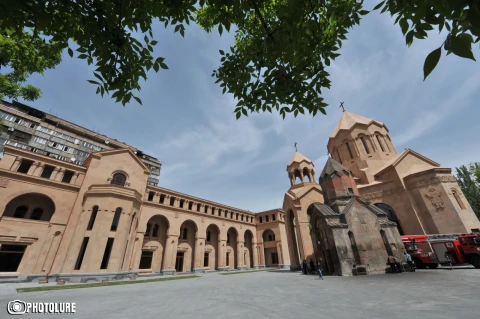
The only clearly documented event in Armenia appears to be the armspyurk signature drive, which took place on April 5 in the courtyard of the Mother See of Holy Etchmiadzin in support of the Armenian Apostolic Church. Photos were published from that event, but no evidence was found confirming other major rallies in Armenia.
Online platforms revealed only isolated posts about actions held in several Russian cities: on March 22 in Kaliningrad, on March 29 in Rostov-on-Don, on April 1 in Moscow during Nikol Pashinyan’s visit, and on April 5 in Volgograd. Published materials show relatively small gatherings rather than the kind of wide-ranging international mobilization described in publications by Evrazia and sources linked to it.
As for the other countries mentioned such as the United States and France, no photos, videos, news reports, social media posts, or other public evidence of such actions were found. Despite the lack of evidence for large-scale gatherings, from March 30 to April 6 more than 105,000 new signatures were added to the armspyurk.com website.
The growth dynamics of the number of signatories raise questions. On the morning of April 3, Badalyan posted a screenshot on Telegram showing the number of signatories at 138,705. Twelve hours later he posted a new screenshot showing 147,878 signatures. At the same time, that day he did not report any signature drive or other event that could explain such an increase.
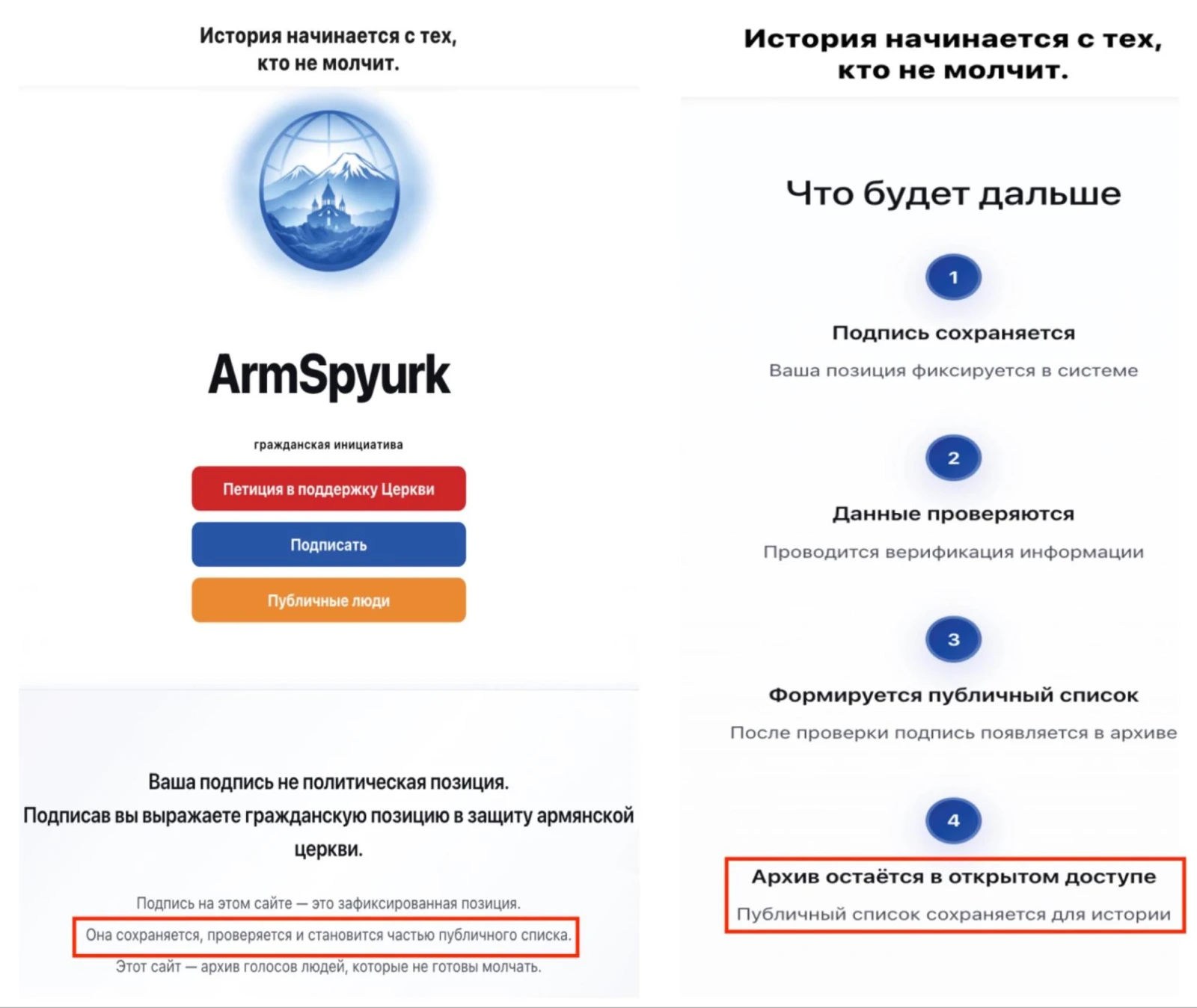
Using the Wayback Machine service, which preserves archived versions of websites, we gained access to a previous version of armspyurk.com, before it turned into an information portal in March 2026, and found that the site informed signatories that their signatures would be checked and added to a public database. The site also stated that signing means that “your position is recorded, verified, and becomes part of a public list,” presenting that archive as evidence of a mass civic movement. However, no such list exists either on the current or the archived version of the site, making it impossible to independently verify the signatories’ identities.
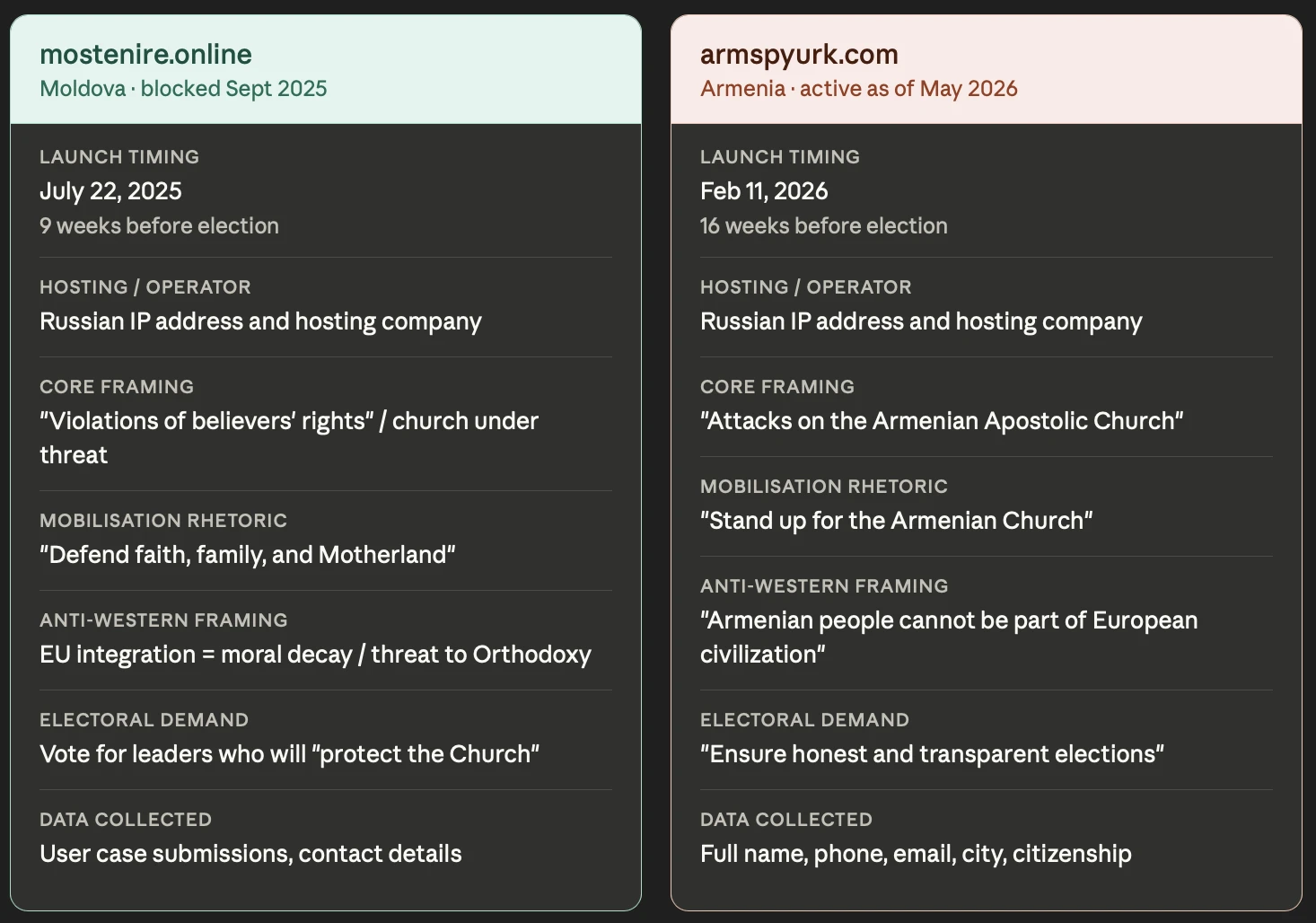
Armspyurk.com is not a unique website. It closely resembles mostenire.online, a site that was used in Moldova ahead of the September 2025 elections and later blocked by Moldovan authorities. According to an investigation by RISE Moldova, mostenire.online was linked to a Russian citizen living in occupied Crimea. The site was hosted on Russian servers and used the same religious rhetoric and data-collection mechanisms. Like armspyurk.com, mostenire.online also presented itself as a multinational civic initiative defending the Orthodox Church and “traditional values.” It ran a signature drive, collecting users’ names and phone numbers, and was actively spread via Telegram, TikTok, Facebook, and Instagram networks linked to Russia.
In one mobilization video published two weeks before Moldova’s parliamentary elections, a Moldovan clergyman warns of the possible implementation of a “Ukrainian scenario” in Moldova. At the end of the video, he calls on viewers to follow the petition link and “go vote.” Armspyurk and Mostenire not only use the same hosting model, they are also built on the same narrative structure and the same approach to collecting personal data from signatories.
Targeting the diaspora and transporting voters, financed by Evrazia
Ahead of Moldova’s elections, authorities documented a coordinated operation by Ilan Shor and Evrazia (Shor is a member of the organization’s board of trustees) to mobilize diaspora voters living in Russia. The operation was carried out through organized air and ground transportation. According to Moldovan police, citizens were flown from Russia to transit hubs, including Istanbul, from where they were taken by buses to Moldova along routes crossing multiple countries.
In a number of documented cases, voters did not pay for either plane tickets or bus transport, indicating external financing of the transfers.
On March 10, 2026, Armenia’s Foreign Intelligence Service issued a statement about possible pressure on Armenian citizens abroad and interference in upcoming electoral processes. The Investigative Committee initiated criminal proceedings.
According to the statement, authorities said they had obtained evidence that leaders, officials, and other representatives of certain political parties were using financial incentives to influence voters and interfere with the free exercise of electoral rights. According to the agency, individuals posing as representatives of a foreign intelligence service were pressuring Armenian citizens living abroad to support certain political forces participating in the election. In return, they were promised organized travel to Armenia, reimbursement of travel expenses, and coverage of accommodation costs.
Two days later, in a video published on Telegram, Mika Badalyan urged Armenians living in Russia to contact him if they wanted to participate in Armenia’s elections, noting that he would try to help everyone.
On May 3, he wrote: “All those who need help purchasing tickets to participate in the elections, as well as those who are ready to take part in buying tickets for our partners, write to @mbadalyan.”
In another video published on May 31, Badalyan said they now had greater opportunities to help those wishing to travel to Armenia with plane tickets and again urged people to contact him.
On June 3, the Anti-Corruption Committee announced it had obtained factual data according to which Badalyan had offered vote bribes to hundreds of Armenian citizens living in Russia. The Committee said criminal proceedings had been initiated and actions were underway to identify individuals who allegedly received the bribes.
As part of a separate investigation, CivilNet journalists, posing as Armenians living in Russia, examined the process of providing plane tickets organized by Badalyan. For several weeks they remained in contact with Badalyan and his associates, provided personal data, and received information about flights. The full investigation is available here.
Systematic dissemination of anti-Western narratives
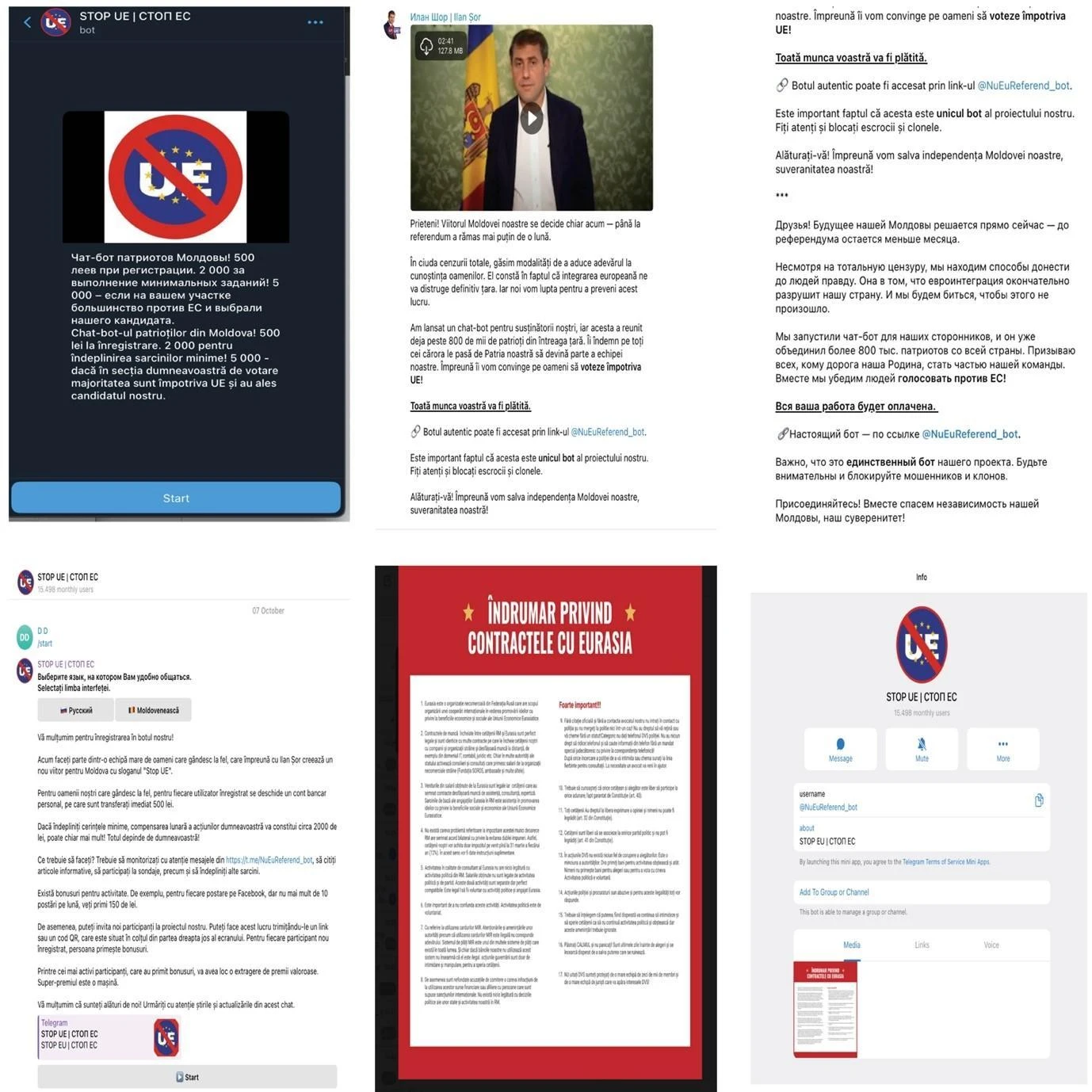
DFRLab previously revealed that Evrazia supported a Telegram chatbot campaign called STOP UE / СТОП ЕС, under which Moldovan citizens were financially incentivized to spread anti-European content. To receive payments for bringing new participants into the disinformation network, users first had to sign a contract with Evrazia.
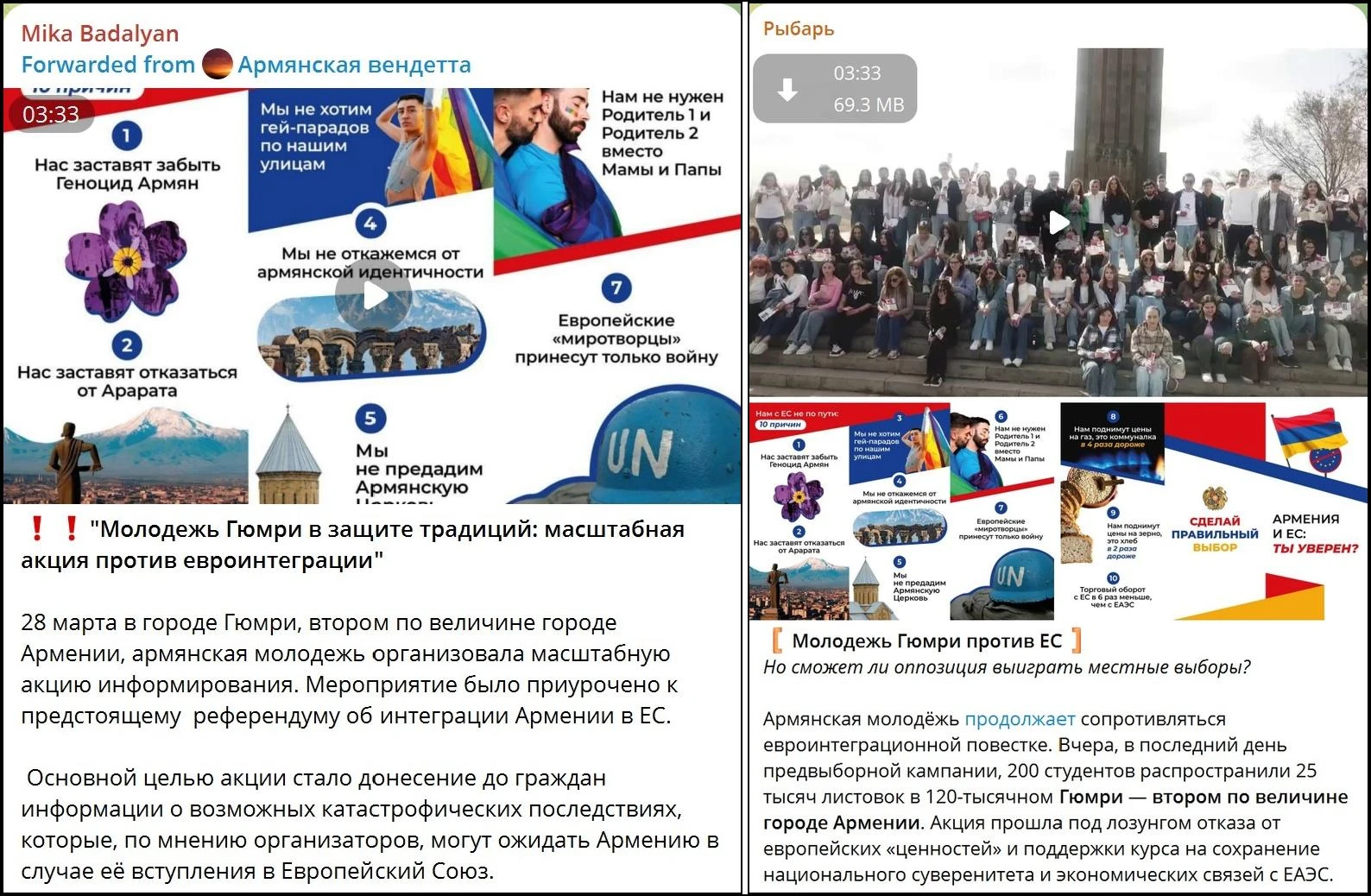
In Armenia, a similar anti-European campaign spread through Mika Badalyan and channels linked to him. Two days before the Gyumri elections, young people were distributing anti-European leaflets in the city’s streets, claiming that EU integration threatens Armenia’s traditions and values. Past.am reported that the campaign was organized by Evrazia.
Badalyan neither confirmed nor denied Evrazia’s involvement in the campaign carried out in Gyumri. However, using facial recognition tools we were able to identify some of the young people who appeared in the videos. One of them is currently a supporter of the “Strong Armenia” party, while others appear in photos published from various Evrazia events.
Later, that campaign was mentioned at the “Evrazia: Territory of Values” conference held in Moscow. During the conference, Alpha News editor-in-chief Tigran Kocharyan emphasized broad coverage of Russian initiatives in Armenia and presented the Gyumri action as a successful example.
Evrazia’s activities in both Moldova and Armenia do not appear to be isolated initiatives, but rather different manifestations of the same modus operandi. In both countries, the organization has used similar tools, including religious and civic initiatives, humanitarian programs, diaspora mobilization, and information campaigns, to build political influence.
In Moldova, this activity has been widely documented, and Evrazia has been recognized as a national security threat. In Armenia, however, the organization continues to operate freely.


 Stories