By Siranush Adamyan
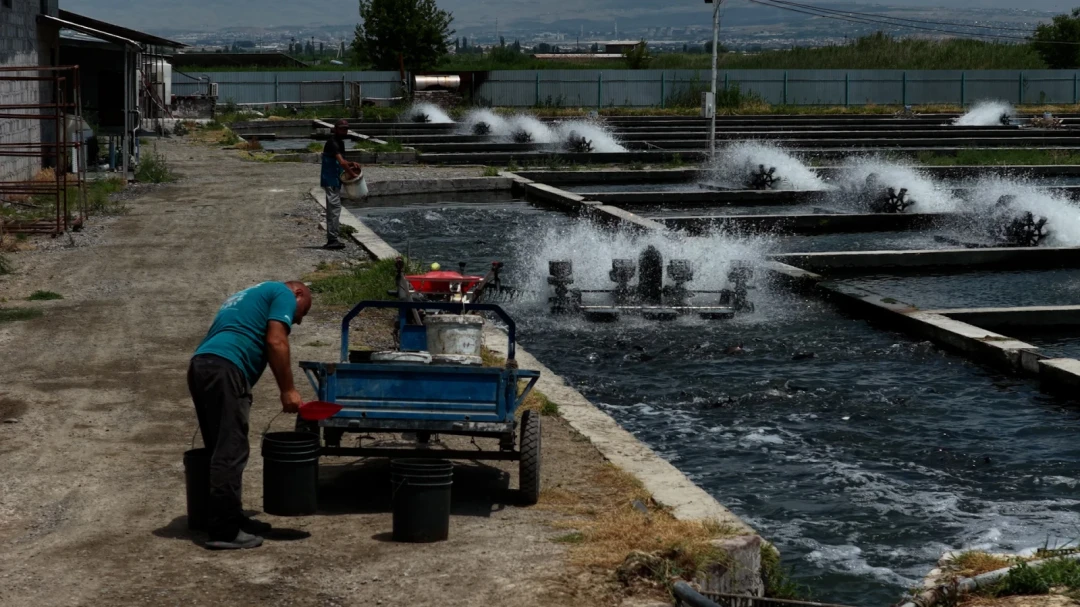
Every day, more than four tons of trout are raised in the ponds of Art-Fish fish farm in Armenia's Ararat region. Until recently, almost all of that production was destined for Russia. Now, the fish remain in the ponds as the company's management searches for a market.
Russia suspended imports of fish and fish products from Armenia on June 2, leaving producers facing mounting costs with few immediate alternatives.
Operating costs continue to mount every day, said Art-Fish CEO Artyom Torosyan, noting that the company must keep its ponds running and continue feeding the fish despite losing its main export market. "These are living animals. We can't switch off the electricity or stop feeding them. We have large loans, taxes to pay and significant investments in the business," he said.
Russia has long been the backbone of Armenia's fish exports. In 2025, Armenia exported around 10,000 tons of fish and fish products to Russia. The country's total fish exports were worth about $80 million, with roughly 98% shipped to the Russian market. Art-Fish alone exported 540 tons of fish last year.
Also read: Armenia faces sweeping Russian import restrictions across industries
Torosyan said the company never anticipated losing access to its primary market and is not prepared to redirect exports elsewhere.
"Finding new markets requires a great deal of time and substantial investment," he said. "If we want to export to Europe, we need processing facilities that meet European standards. As far as I know, there isn't a single facility in Armenia capable of processing our fish and exporting it to Europe under those standards."
The Russian restrictions are part of a broader series of import bans affecting Armenian exports, including flowers, mineral water, fruit and vegetables, and alcoholic beverages, amid deteriorating trade relations between the two countries.
Fish farmers say the government's support measures have largely bypassed their industry. While transport subsidies have been introduced for several agricultural products, aquaculture has received no comparable assistance.
"I don't understand why flowers receive subsidies, peppers receive subsidies, brandy receives subsidies, and strawberries receive subsidies, but fish farming is ignored," Torosyan said. "We exported 540 tons of fish last year, brought billions of drams into Armenia, paid substantial taxes and employed many people. Yet the government's response has been zero."
Also read: Armenia's flower producers scramble to replace Russian market
Without exports or state support, producers say they cannot continue operating for long.
"Without exports, fish farms cannot survive for more than 10 days," Torosyan said. "The business worked as a cycle. We exported fish, received payment, paid taxes, repaid loans, bought feed, and paid wages. That cycle has now been broken for more than a month."
To keep the business afloat, he has applied for another bank loan while waiting to see whether exports can resume.
Selling the fish domestically is not a viable solution, producers say. Armenia's domestic market is too small to absorb the volumes previously exported to Russia. If producers are forced to sell locally, supply will surge, prices will fall, and farms will face even greater financial losses.
Industry representatives warn that unless exports resume or meaningful government support is introduced, many fish farms may struggle to maintain production or survive.



 Stories