By Hayk Ghazaryan
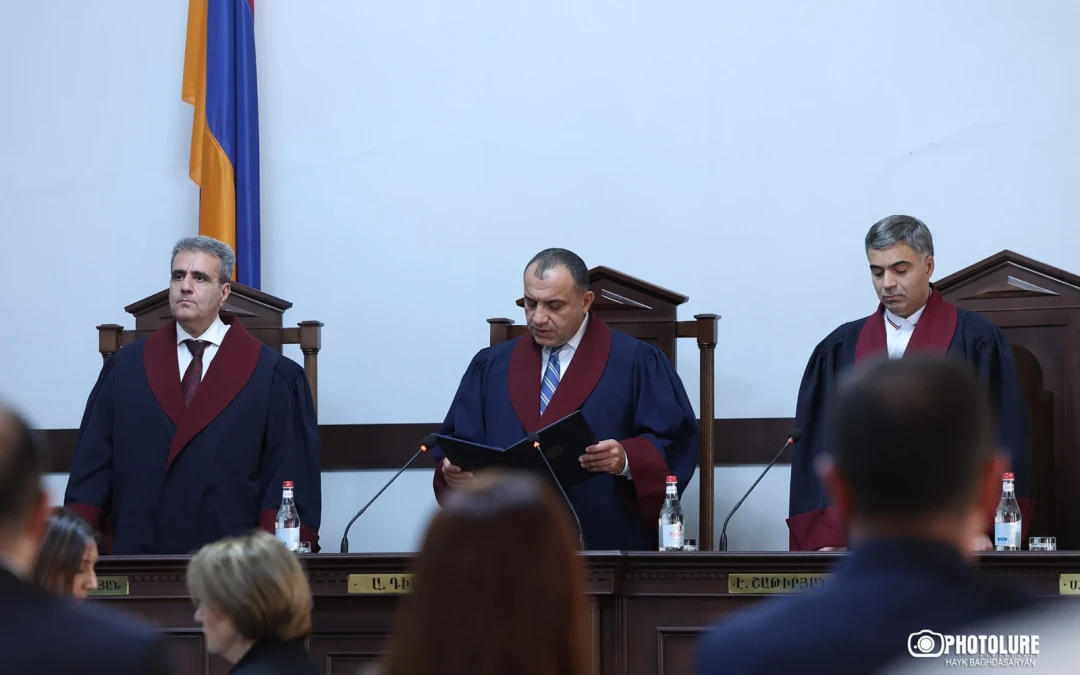
Armenia's Constitutional Court on Saturday upheld the official results of the June 7 parliamentary election, rejecting appeals by seven political forces and confirming a result that left the Prosperous Armenia Party just below the threshold for parliamentary representation.
The ruling brings to an end nearly a month of legal challenges following the vote and confirms the Central Election Commission's controversial decision to invalidate the results from three polling stations without ordering repeat voting.
Prime Minister Nikol Pashinyan's Civil Contract party will retain its parliamentary majority with 64 seats, while the Strong Armenia alliance, led by Russian-Armenian businessman Samvel Karapetyan, will hold 29 seats, and former President Robert Kocharyan's Armenia Alliance will have 12. Civil Contract also receives three additional seats reserved for ethnic minorities, while Strong Armenia receives one seat reserved for ethnic minorities.
Also read: Civil Contract wins as Prosperous Armenia's threshold result could alter seat distribution
The court's decision is particularly significant for the Prosperous Armenia Party, which finished with 3.95% of the vote, narrowly below the 4% threshold required to enter parliament.
Prosperous Armenia and other opposition parties argued that the election commission should have held repeat voting in the three annulled precincts rather than simply excluding their votes from the national tally. They maintained that the decision deprived the party of its opportunity to win parliamentary representation.
The invalidation proved decisive. Had Prosperous Armenia crossed the threshold, it would have won five seats, while Civil Contract would have held 61 seats instead of 64.
The Constitutional Court rejected those arguments, leaving the election commission's decision intact.
Disputed polling stations
The dispute centered on three polling stations whose results were annulled after election day due to serious violations, including one in the southern town of Agarak, where dozens of servicemen were reported to have voted after the polling stations had officially closed.
The Central Election Commission argued that repeat voting would itself undermine equality because those voters would already know the nationwide outcome.
"From the perspective of equal suffrage... a repeat vote may undermine the principle of voter equality," the commission said, arguing that voters would cast ballots under substantially different circumstances from the rest of the electorate.
Opposition parties disagreed, saying the decision altered the distribution of parliamentary seats.
Political analyst Tigran Grigoryan, director of the Regional Center for Democracy and Security, argued that the ruling effectively changed the composition of parliament. "[The decision] deprives a political force that received sufficient electoral support of the opportunity to enter parliament, while artificially granting the ruling party three additional seats in clear violation of the law," he told CivilNet. Grigoryan also warned that the decision "endangers one of the principal achievements of 2018, the institution of free and fair elections."
The court's ruling makes the election results final and cannot be appealed.
Although Civil Contract retains a comfortable majority, it fell short of the two-thirds supermajority needed to initiate a constitutional referendum through parliament. The party had previously pledged to adopt a new constitution, but under the confirmed results, it cannot launch that process unilaterally.




 Stories