By Siranush Adamyan
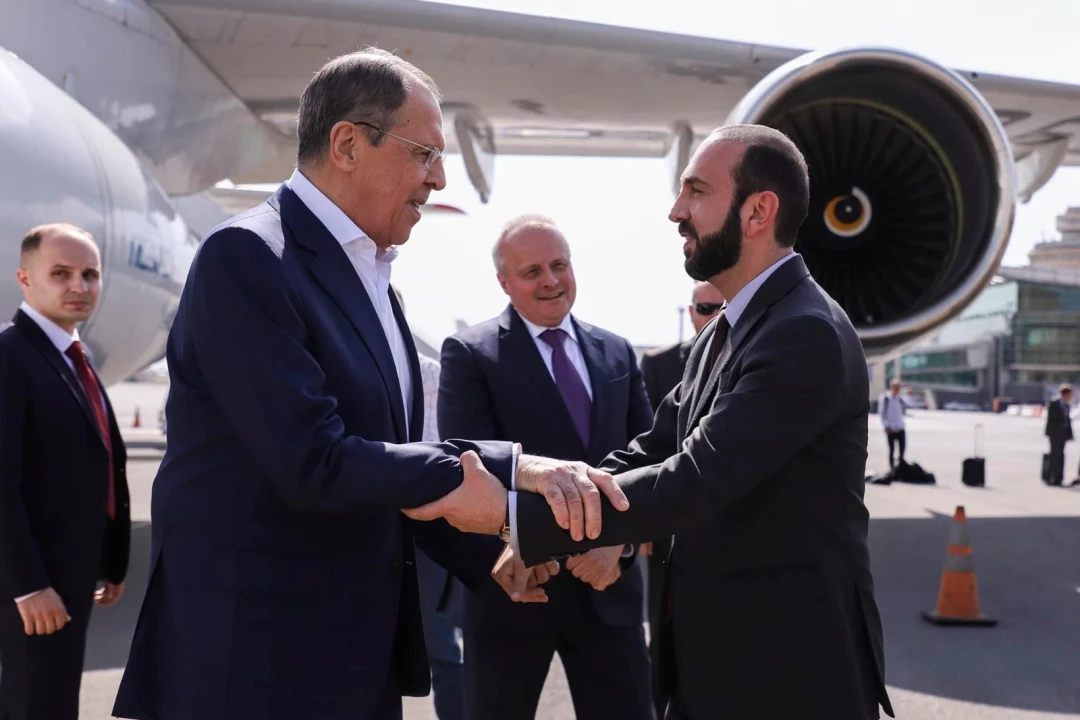
Russia remains “more than a strategic partner” to Armenia because existing treaties make the two countries allies, Foreign Minister Ararat Mirzoyan said, while acknowledging problems in bilateral relations and calling for ties to be put on a healthier footing. “Russia, in legal, political and economic terms, is in fact more than a strategic partner of the Republic of Armenia,” Mirzoyan said. “We have treaties that make us allies, which is more than a strategic partnership.”
Mirzoyan made the comments in an interview broadcast on Armenia’s Public Television on Monday evening. The interview was recorded in Gyumri, where senior Foreign Ministry officials and the heads of Armenia’s diplomatic missions abroad are holding their annual gathering.
The minister was responding to a question about Armenia’s new 2026-2031 government program, which significantly changes the language used to describe relations with Moscow.
The previous five-year program referred to an “Armenian-Russian strategic alliance” and pledged to strengthen “allied relations and strategic partnership.” The new program instead speaks of the “transformation and deepening” of partnership with Russia and no longer uses the terms “allied relations,” “strategic partnership” or “strategic alliance.”
Also read: Russia no longer a ‘strategic ally’ in Armenia’s new government program
Mirzoyan said the change in wording should not be interpreted as meaning that Russia was no longer Armenia’s ally.
He pointed to the two countries’ bilateral agreements, including obligations in the defense sphere, as well as their membership in the Eurasian Economic Union.
At the same time, Mirzoyan acknowledged that problems had emerged in relations in recent years. He cited statements by Russian politicians and officials, coverage in Russian media and Moscow’s restrictions on imports of some Armenian products, including agricultural goods, flowers, mineral water and alcohol.
“We need to review certain aspects of our relations, make them healthier and return them to a course of mutual respect and respect for each other’s interests,” Mirzoyan said. “We believe our Russian partners should show greater respect for our right to make independent decisions,” he added.
Mirzoyan also criticized restrictions on Armenian exports to Russia, saying Armenia had fulfilled its obligations as a member of the Eurasian Economic Union and should enjoy the rights that come with membership.
He said restrictions based on problems identified in a particular shipment would be understandable, but questioned broader measures imposed before products had even reached the Russian market. “The apricot harvest had not even been collected when the import of apricots was banned,” he said. “This is not healthy. I can say even more: this is a violation of EAEU rules.”
Despite the disagreements, Mirzoyan said Yerevan did not want to escalate tensions or enter into a public exchange of accusations with Moscow. “We do not want to intensify this discussion or enter into a war of words,” he said. “We want to sit down in a constructive atmosphere, as friends, and resolve all the issues.”
Future of Russian-managed railways
Mirzoyan also addressed uncertainty over the future of Armenia’s railway network, which is operated by South Caucasus Railway, a subsidiary of state-owned Russian Railways, under a concession agreement signed in 2008.
Prime Minister Nikol Pashinyan has called on Moscow to sell the concession rights either to Armenia or to a third country acceptable to both Yerevan and Moscow. He has argued that Russian management of the network risks preventing Armenia from taking advantage of what he has described as a historic opportunity to integrate into emerging international transport routes.
Also read: Pashinyan renews calls on Russia to give up Armenia’s railways
Mirzoyan echoed that argument, saying the reopening of regional transport links gave Armenia a chance to become a key link in East-West transportation. “Armenia cannot afford to miss this opportunity,” he said. “We have this opportunity and we are going to realize it.”
Mirzoyan said one obstacle was that some potential participants in the emerging transport system were unwilling to use Armenia’s existing railway infrastructure while it remained under Russian concession management. “This means that we miss this historic opportunity,” he said. “This is not just another opportunity or another business project, even a very large one. This is a historic opportunity, and we are not going to miss it.”
He said the railway network and rolling stock also required substantial modernization and that discussions with Moscow suggested the Russian side was not prepared to make the necessary investments in the broader network.
Yerevan had therefore proposed that Russia sell its concession rights to Armenia or to a third country acceptable to both sides, allowing Moscow to protect its interests while Armenia integrates its railway system into new international routes.
Mirzoyan said Kazakhstan was among the options discussed but stressed that no specific country had been selected.
“We respect their interests and do not want to infringe on them, but a solution has to be found,” he said. Mirzoyan described Moscow’s initial reaction to the proposal as “somewhat colder,” but said disagreements of that kind were normal even between close partners.
“We will find a solution in which we benefit and do not upset our friends,” he said.
Russia has not rejected investment in Gyumri-Kars, Yeraskh links
Mirzoyan drew a distinction between the future of the overall railway concession and a separate discussion over investment in infrastructure needed to reconnect Armenia by rail with Turkey and Azerbaijan.
He said the Gyumri-Kars railway through Akhurik should be brought back into operation, while infrastructure would also be needed around Yeraskh as regional rail connections are restored. Mirzoyan said the relevant infrastructure on the Armenian side in the Gyumri-Kars and Yeraskh sections does not currently exist in a usable form.
“To call it reconstruction would not even be correct. It has to be built,” he said.
Because those sections are part of the railway network managed by South Caucasus Railway, Mirzoyan said it was logical for Armenia to expect the Russian operator to make the necessary investment, or for the sides to agree on how the investment would be shared.
He noted that efforts were already underway to enable cargo from Turkey to reach Armenia by a longer railway route through Kars, Akhalkalaki and Georgia. Mirzoyan welcomed that development but said a direct railway link between Armenia and Turkey would be shorter and more economical.
“We have one missing piece that has to be built,” he said.
On whether Russia was prepared to finance the work, Mirzoyan said the latest signal he had received, “literally two or three days ago,” suggested Moscow was ready to discuss the details.
“They are ready to understand and discuss the nuances — who invests how much, how it is done and so on,” he said.
Asked whether that meant Russia had not rejected the proposal, Mirzoyan said it had not.
“If you say there is an issue and people respond, ‘Let’s understand how we can do it,’ that is not a rejection,” he said.
Mirzoyan said relevant Armenian government agencies would now become involved in more substantive discussions over the financing and implementation of the projects.
The comments come ahead of an expected meeting between Pashinyan and Russian President Vladimir Putin in Bishkek on Tuesday on the sidelines of the Shanghai Cooperation Organization summit.

 Stories