By Siranush Adamyan
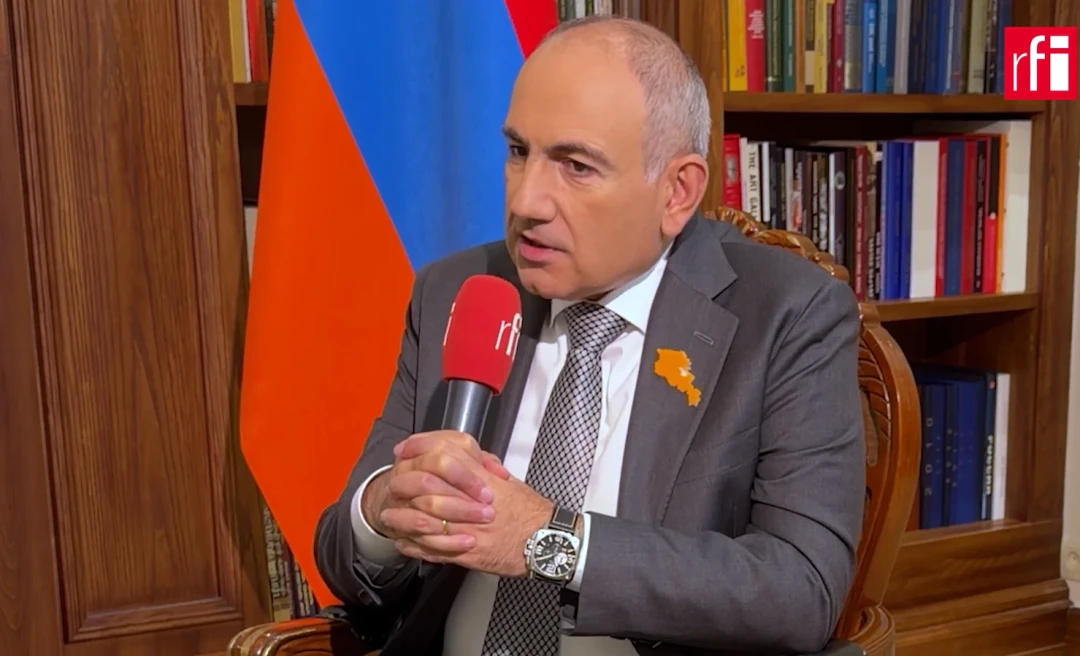
Prime Minister Nikol Pashinyan rejected warnings that Armenia could become a “second Ukraine,” a scenario recently raised by Russia’s Security Council Deputy Chairman Dmitry Medvedev, while saying his government wants to develop relations with Moscow.
In an interview with RFI’s Armenian-language service published on Monday, Pashinyan was asked about Russian politicians’ warnings that Armenia could become a second Ukraine.
“I don’t think so,” he said. Asked whether he believed that would not happen, he replied: “Yes, I believe that, and I am convinced.”
The interviewer did not name Medvedev, but the question echoed his recent warning about Armenia’s foreign policy shift.
“The current Armenian leadership decided it was right to change the direction of its development. I am certain that this, too, will lead to nothing good. The worst thing that could happen to Armenia is its transformation into a new Ukraine,” Medvedev said in an interview with Iran’s state broadcaster, according to an RBC report published on October 4. He also posted a video of the interview on the messaging platform Max.
Medvedev accused the West of testing the strength of relations between Russia and Armenia.
Asked whether such warnings upset him, Pashinyan said: “My job is not to be upset or not upset. My job is to address the issues facing the Republic of Armenia, and that is what I am doing.”
He confirmed that he would continue seeking good relations with Russia while pursuing closer ties with the European Union.
“Severing or worsening our relations with Russia has never been, is not and will never be among our goals,” Pashinyan said. “On the contrary, we want to develop our relations with Russia.”
He nevertheless said the relationship could not remain the same as before, regardless of the political leadership, because the regional situation had changed.
“Previously there was conflict with Azerbaijan, and now there is peace,” he said.
Armenia and Azerbaijan initialed a peace agreement in Washington in August 2025, though the treaty has yet to be signed. Pashinyan argued in the interview that peace had already been established in practice.
Creating alternatives
Pashinyan described his government’s foreign policy as an effort to strengthen Armenia’s independence by expanding its choices. He said the aim was not to replace dependence on one country with dependence on another.
“Independence means replacing dependence on a few with dependence on many,” he said.
That approach also applied to the economy, he added. Armenian businesses, including tomato growers and beverage producers, needed more options for both exports and imports.
As an example, Pashinyan said dozens of companies now imported fuel into Armenia, compared with a small number previously. He credited that diversification with shielding Armenia from fuel supply problems in Russia linked to Ukrainian actions.
The aim, he said, was to avoid problems in Armenia or improve the country’s ability to manage them.
On EU membership, Pashinyan said Armenia had not yet submitted a formal application and still needed substantial reforms to meet the bloc’s standards. In late August, he said Armenia would soon begin the process of submitting an application.
He presented EU membership as one possible outcome, alongside remaining in the Russian-led Eurasian Economic Union or belonging to neither bloc. The ultimate choice, he said, should rest with the Armenian people, while accession would also depend on the EU’s willingness to admit Armenia.
Russian President Vladimir Putin has said Armenia’s law launching the EU accession process effectively amounted to an application to leave the Eurasian Economic Union.
Pashinyan said Armenia would pursue reforms to meet EU standards even if membership did not follow, arguing that the country would still benefit.

 Stories