 Hrair Balian

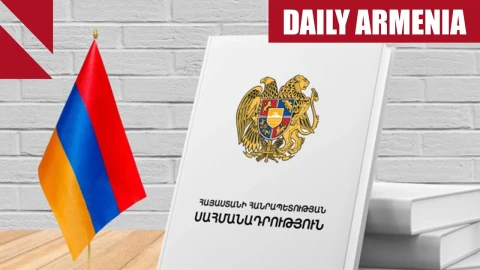
Armenia is heading toward a new constitution. The reason is external: President Ilham Aliyev will not sign the peace treaty initialed in Washington in August 2025 while the Armenian constitution’s preamble refers to the 1990 Declaration of Independence.[1] Because the preamble cannot be amended, only a new constitution adopted by referendum can remove it.[2] The drafting process so far has been closed. The Justice Ministry wrote the draft, the ruling party reviewed it first, and the Constitutional Reform Council was largely bypassed.[3] Prime Minister Nikol Pashinyan promised to publish the text of the draft constitution on November 23.[4]
A new opposition alliance of thirteen forces, formed on 4 November hours after Strong Armenia leader Samvel Karapetyan was arrested again,[5] has answered with a campaign against an “Aliyev constitution”.[6] The rejection is understandable. But the more useful question is not whether Armenia gets a new constitution. It is who writes it, and more importantly what it fixes. On that question the opposition is in a strong position.
The arithmetic is an opportunity
Putting a new constitution to referendum requires 70 of the National Assembly’s 105 votes. Civil Contract has 64. The opposition has 41: Strong Armenia with 29 and the Armenia Alliance with 12. That is more than the 35 deputies, one third of the chamber, needed under Article 202 to table a draft constitution of its own.[7]
Neither side can win alone. The government cannot adopt its text without at least six opposition votes. The opposition cannot block reform forever if defections, pressure on individual deputies or a snap election shift the numbers. When neither side can prevail, the side with a clear proposal sets the terms. Today that side does not exist. The opposition can become the side with a clear proposal.
From “No” to “Yes, but a different constitution”
A flat “No” to an unread text looks strong but is fragile. It merges two separate questions, how to answer Baku’s demand on the preamble and how Armenia should be governed, into a single refusal. It lets the government present itself as the party of modernization and peace. And it protects, by default, the 2015 “super-prime-ministerial” system under which the opposition endures abuses. Even Justice Minister Srbuhi Galyan now uses that term for the current constitution.[8]
The alternative is a counteroffer: “Yes to a new constitution — Armenia’s, written by Armenians, that ends one-man rule.” This keeps the opposition’s core objection about sovereignty. It also ends the government’s monopoly on reform, and gives thirteen very different forces something positive to stand for together, not only something to reject.
What should be fixed
The flaw in the 2015 constitution is not the parliamentary model as such. It is that the winner of a parliamentary majority takes everything: the executive, the legislative agenda and, in practice, the bodies meant to check both. Civil Contract’s 64 seats alone exceed the three-fifths (63 votes) needed to elect Constitutional Court judges, non-judicial members of the Supreme Judicial Council and the prosecutor general. The prime minister has no term limit. Parliament cannot dissolve itself. The “stable majority” rule manufactures a governing majority out of a plurality.[9] Regional lists were abolished in 2021, leaving the communities outside Yerevan without a voice of their own.
As Civilnet put it, a constitution “should be written with a bad government in mind.”[10] A better design would rest on the following few principles:
• Two separate mandates. A directly elected president with limited but real powers — a suspensive veto, a shared role in foreign and defence policy through a security council with defined membership — and a parliament elected on its own cycle. This is not a return to the pre-2015 presidential system, which simply concentrated power elsewhere.
• A prime minister answerable to parliament. Investiture, a constructive vote of no confidence, a two-term limit, and no presidential power to dismiss the government. Comparative evidence shows this premier-presidential variant has a far better democratic record than systems where presidents can fire governments, which have often slid into super-presidentialism, as in Russia and Azerbaijan.[11]
• Coalitions, not manufactured majorities. Remove the stable-majority bonus, use moderate thresholds, and introduce a mixed electoral system that restores regional constituencies.
• Independent bodies beyond the majority’s reach. Two-thirds approval for key appointments, an opposition share and anti-deadlock rules.
• Protection against self-serving amendment. Four-year parliaments, self-dissolution by two thirds, and an electoral system that does not benefit those in office.
Lithuania offers the closest post-Soviet model of stable alternation. Finland shows that the balance can be adjusted as democratic habits mature. Georgia and Ukraine are the warning: constitutions rewritten again and again to suit incumbents.
Six steps from here
1. Separate the two questions. Treat the preamble and the governance model as distinct decisions. Options include a separate referendum question on the preamble, a preamble grounded in the continuity of statehood and the 21 September 1991 independence referendum, or an agreement to settle the preamble last. Whatever the outcome, the 1990 Declaration remains a historic act.
2. Publish an alternative framework within weeks. A short statement of principles first, then a full text, drafted by constitutional lawyers, civil-society members of the Reform Council who have criticized its sidelining, and outside experts.
3. Table it formally, either through the 35-deputy initiative or a 200,000-signature campaign. A signature drive would itself build public support for a positive agenda.
4. Set terms for public discussion: publication of the government draft, an alternative opposition draft constitution, Venice Commission opinions on both texts, and no referendum before public discussion is complete.
5. Name the price of six votes. Make it concrete and verifiable: the term limit, four-year parliaments, self-dissolution, two-thirds thresholds for key appointments, removal of the stable-majority rule and regional representation.
6. Prepare for both outcomes. If the government negotiates, the opposition shapes the constitution. If it refuses, the opposition goes into the next election with a program, not only a grievance.
Once the government text appears, the opposition should respond chapter by chapter, supporting genuine improvements such as jury trials, two-tier appeals and a constitutional guarantee for the opposition minority, and holding firm where the design keeps power concentrated.
Turning the 2015 legacy into an asset
The Republican Party designed the 2015 system, and the government will say the opposition is defending a constitution its own members wrote to stay in power. If the opposition alliance simply defends the 2015 text, that charge will stick. If instead the Republicans say openly that the design concentrated too much power and back its correction, the argument disappears. Their inside knowledge of how the system was built becomes a resource. The same design has served Civil Contract since 2018; the flaw lies in the constitutional institutions, not only in those who held office. A reform coalition that includes the authors of the 2015 system would show that the correction is a shared national project.
The risks are manageable
Some supporters will see separating the preamble from governance as yielding to Baku. Keeping sovereignty language central, and letting voters decide the preamble on its own, answers that. The alliance’s internal differences over Artsakh, Russia and the West are real, which is why governance principles should be agreed first and contested issues left for later. If the government ignores a counter-draft or calls snap elections, the opposition’s constitutional draft becomes the campaign platform. And if Baku raises new demands after the constitution changes, that belongs at the negotiating table where red lines must prevail;[12] it should not decide how Armenia governs itself.
A constitution for whoever governs next
Armenia’s opposition faces a choice between a refusal that may hold for a while and a proposal that can last. The first leaves the government in charge of the reform story and keeps the old system in place. The second turns forty-one seats into leverage, gives a diverse alliance a common purpose beyond a mere “no”,[13] and offers citizens what neither the 2015 text nor the government’s draft promises: a state in which no single election result hands one leader everything.
The strongest message available is not “No to Aliyev’s constitution.” It is “Yes to Armenia’s constitution — and no to one-man rule.”
. . .
Hrair Balian has served in leadership positions with the UN, the OSCE/ODIHR, and NGOs, including The Carter Center and the International Crisis Group. During a 35-year career in public service, he has worked on conflict resolution, elections and human rights in the Balkans, Eastern Europe, Caucasus, Central Asia, Middle East and Africa. He has taught conflict resolution, negotiations, and mediation at the Emory University School of Law. Books published – Anatomy of Peacemaking: Nagorno-Karabakh Conflict & Missed Opportunities (Springer Nature / Palgrave Macmillan, February 2026); Armenian translation (Newmag, April 2026).
[1] Horizon Weekly, Editorial. No to an Imposed Constitution, 11 November 2026, https://horizonweekly.ca/en/editorial-no-to-an-imposed-constitution/
[2] Azatutyun (RFE/RL Armenian Service), Armenian Opposition Slams Pashinian’s ‘Pro-Azeri’ Constitution,
https://www.azatutyun.am/a/33829062.html
[3] Armenpress, Pashinyan administration plans to publish draft new Constitution in November, 2 November 2026, https://armenpress.am/en/article/1264450
[4] Civilnet, Draft Constitution to Be Published on Monday, 20 November 2026, https://civilnet.am/en/video/1015543
[5] OC Media, Armenian opposition forms alliance against plan to amend constitution following Karapetyan arrest, 5 November 2026, https://oc-media.org/armenian-opposition-forms-alliance-against-plan-to-amend-constitution-following-karapetyan-arrest/ ; Caucasus Watch, Thirteen Armenian Opposition Forces Launch Joint Initiative Against Proposed Constitutional Changes, 11 November 2026, https://caucasuswatch.de/news/13685
[6] Caucasian Knot, The opposition of Armenia announced actions against the change of the Constitution, 8 November 2026, https://www.eng.kavkaz-uzel.eu/articles/80047
[7] Council of Europe, Venice Commission, Constitution of the Republic of Armenia (2015), Article 202(1), https://www.te.gob.mx/vota_elections/thesaurus/article/21873/16287/188 ; see also International IDEA, Constitutional Law on Referendum (2018), HO-155-N, https://constitutionnet.org/vl/item/armenia-law-referendum
[8] Siranush Avagyan, Armenia’s new constitution to drop some ‘super-prime-ministerial’ elements, justice minister says, CivilNet, 15 November 2026, reprinted in Yerepouni Daily News, 16 November 2026, https://www.yerepouni-news.com/armenias-new-constitution-to-drop-some-super-prime-ministerial-elements-justice-minister-says/.
[9] Tigran Grigoryan and Karena Avedissian, Armenia’s Ruling Party Resists Amending Controversial Constitutional Clause, RCDS, 30 September 2026, https://rcds.am/?p=1178 ; Hranoush Dermoyan, Armenia’s Stable Majority Constitutional Provisions Under Review, EPDE Policy Alert No. 5, 24 September 2020, https://epde.org/?p=9185
[10] Karen Harutyunyan, How Armenia’s opposition could force a constitutional dilemma, CivilNet, 8 November 2026, https://civilnet.am/en/news/1015271
[11] Matthew S. Shugart and John M. Carey, Presidents and Assemblies: Constitutional Design and Electoral Dynamics (Cambridge University Press, 1992); Robert Elgie, Semi-Presidentialism: Sub-Types and Democratic Performance (Oxford University Press, 2011).
[12] Hrair Balian, Red Lines Without Deterrence: The Risk of Peace by Capitulation, Civilnet, 22 October 2026, https://civilnet.am/en/news/1014936
[13] Raffi Ardaljian, Ո՛չ միայն ընդդիմութիւն, այլեւ քաղաքական այլընտրանք, Horizon, 20 November 2026, https://horizonweekly.ca/en/ո՛չ-միայն-ընդդիմութիւն-այլեւ-քաղաքակ/


 Stories