 Civilnet
By Mark Dovich
Armenia’s parliamentary opposition demanded that Prime Minister Nikol Pashinyan resign before walking out of a monthly question-and-answer session with the prime minister at the legislature on Wednesday, as thousands of anti-Pashinyan protesters gathered outside the National Assembly building in central Yerevan.
In a scathing address made directly to Pashinyan, opposition lawmaker Armen Rustamyan accused the prime minister of “failing to defend Armenian interests” in ongoing Karabakh negotiations, to ensure the return of Armenian prisoners of war held in Azerbaijan, and to resolve long-standing economic issues in the country.
Placing blame squarely on the prime minister’s shoulders for Armenia’s disastrous defeat to Azerbaijan in and around Karabakh in 2020, Rustamyan said that “Nikol Pashinyan is not legitimate, and does not have a mandate to make new concessions. He must resign.”
After Pashinyan responded to Rustamyan’s speech by blaming his predecessor, former President Serzh Sargsyan, for “failing in the negotiation process” during his ten-year term, the entire opposition delegation abruptly got up and walked out of the legislative chamber.
As the lawmakers from the Armenia Alliance and I Have Honor Alliance, the two opposition parties in the legislature, left the building, Pashinyan accused them of “running away, as you always have.”
“Long live Armenian democracy!” Pashinyan then repeated several times, prompting lawmakers from the ruling Civil Contract party to stand up and give him a standing ovation.
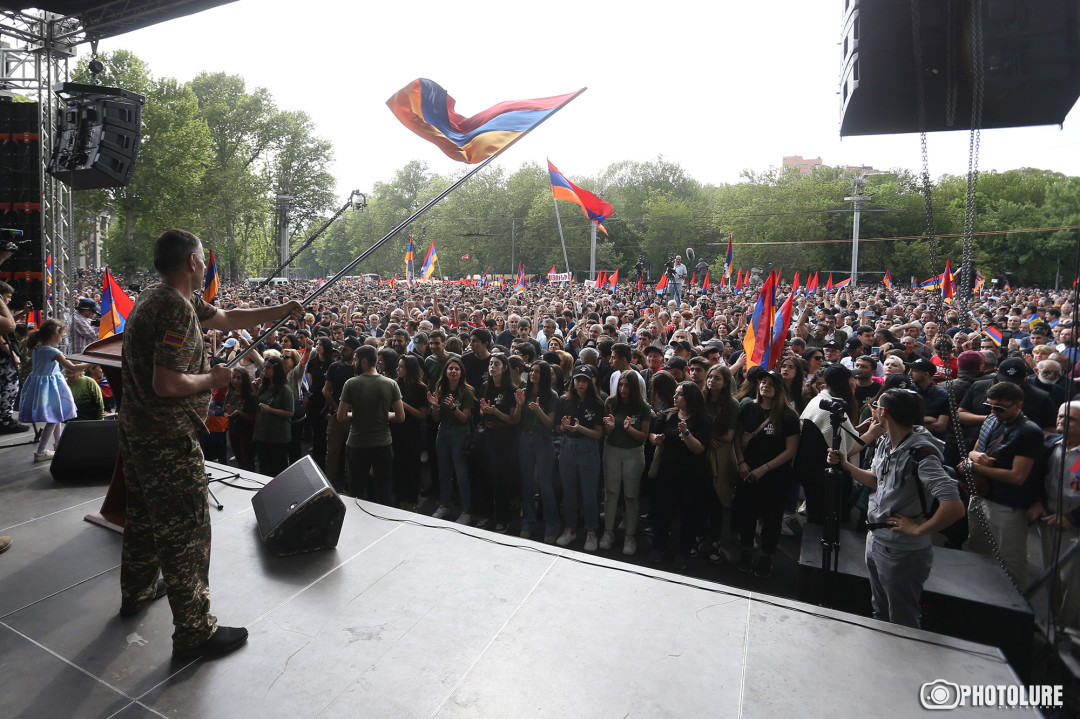
Meanwhile, about 5,000 protesters gathered outside the National Assembly building, where they were met with a heavy police presence, with officers dressed in riot gear stationed around the perimeter of the building.
A scuffle between demonstrators and security services did break out, but fears of wider violence ultimately failed to materialize. Contrary to claims by Armenia’s National Security Service, the protesters did not attempt to storm the National Assembly building.
In a statement released hours before the parliamentary session, the NSS said it had received “reliable operative information” that protest organizers were planning “to instigate unlawful actions” during the session and “incite demonstrators to seize the parliament building.”
Following the question-and-answer session, the protesters moved to France Square, a major intersection in downtown Yerevan that the opposition chose on Sunday as the site of an indefinite sit-in.
Earlier in the day, Yerevan saw a third consecutive morning of acts of civil disobedience in Yerevan, with protesters again blocking major thoroughfares and intersections across the capital.
Wednesday’s actions included parking trucks across the Kievyan and Davtashen bridges, which connect the city to highly populated suburban areas, as well as an overpass connecting Komitas and Baghramyan avenues, two major roads in the north of the city. By late Wednesday morning, all of the blockages had been cleared and traffic was moving, a police spokesman said.
Other demonstrators on Wednesday marched around downtown Yerevan, waving Armenian and Karabakhi flags and chanting anti-Pashinyan slogans, while the opposition continued its sit-in at France Square.
Reports also emerged of protesters closing several highways connecting Yerevan with other major Armenian cities, including the Yerevan-Sevan highway, one of the country’s main arteries.
As of Wednesday afternoon, around 40 demonstrators had been detained in Yerevan, according to the police, who have faced accusations this week of heavy-handedness in detaining demonstrators. Nearly 250 protesters were arrested Monday, and about 160 more on Tuesday.
Kristinne Grigoryan, Armenia’s human rights defender, released a lengthy statement Monday evening “condemning the unlawful actions of police officers” in responding to the protests that day.
In addition to disproportionate use of force, Grigoryan’s office also reported other instances of police misconduct, including detaining demonstrators without explaining charges against them and holding detainees without charge beyond the maximum time limit set out in Armenian law.
In sharp contrast, a number of lawmakers from the ruling Civil Contract party have released statements in support of the police. Alen Simonyan, the parliament speaker and a close Pashinyan ally, said on Tuesday he saw “the actions of the police as generally proportionate.”
Yerevan has seen daily protests since a massive rally on Sunday evening and daily acts of civil disobedience since Monday morning, largely organized by the Armenia Alliance and I Have Honor Alliance.
The surge in protest activity comes in response to a controversial speech Pashinyan gave to parliament early last month that many in Armenia interpreted as an indication of his willingness to cede control over Karabakh to Azerbaijan in ongoing peace efforts.
The speech prompted widespread outrage both in Armenia and in Karabakh, leading thousands of protesters, who have dubbed themselves the Resistance Movement, to come out to the streets, preemptively rejecting any deal with Azerbaijan that would see ethnic Armenians lose control over Karabakh.
In a separate protest on Wednesday, the parents and relatives of soldiers killed during the 2020 war again gathered in front of the prosecutor general’s office in central Yerevan, demanding to file a criminal suit against Pashinyan on charges of allowing “mass murder,” a reference to the prime minister’s role in leading Armenia to military defeat.
The six-week conflict left over 3,800 Armenian soldiers dead, many of them young conscripts. For a small country like Armenia, which has a population of less than three million people, it effectively amounts to a lost generation.



 Stories