 Civilnet
By Mark Dovich
Health code violations or political retaliation?
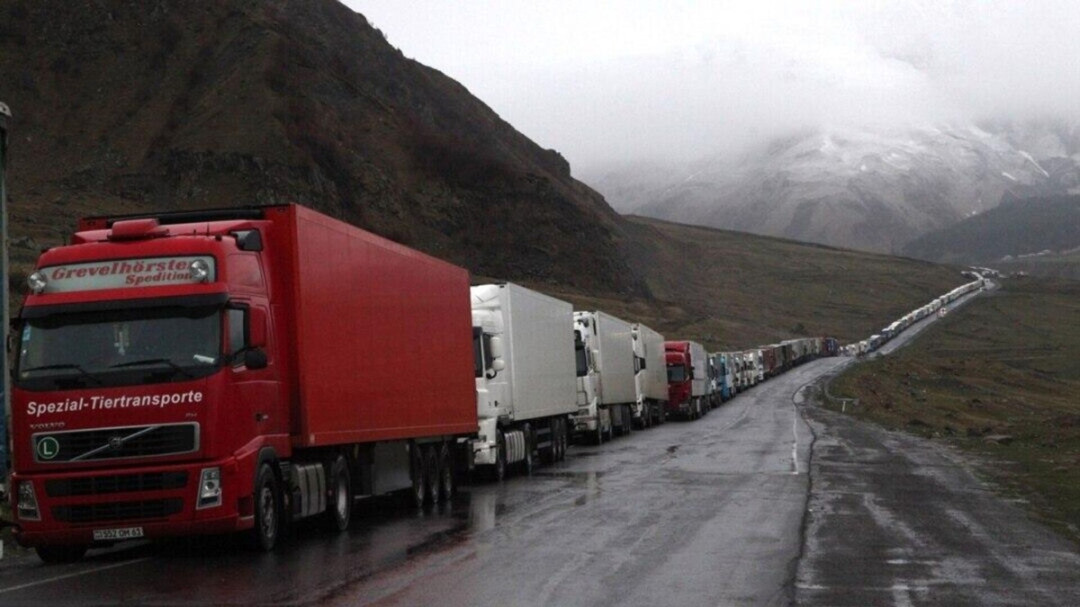
That is the question many are asking as hundreds of Armenian trucks loaded with agricultural goods remain stalled at a key border crossing between Georgia and Russia for alleged sanitary issues, prompting Yerevan to take the rare step of calling an emergency meeting of a Moscow-led trade bloc.
“We have called an emergency meeting (of the Eurasian Economic Union), which will take place within the next two days,” Economy Minister Vahan Kerobyan told reporters Wednesday.
There was no other information made immediately available, as fears grow in Yerevan of a potentially devastating trade war with Moscow.
What’s happening?
Reports of a major pileup began coming out of the Upper Lars checkpoint on Sunday.
While precise numbers have been difficult to come by, Vahan Hakobyan, Yerevan’s customs attaché to Moscow, told Russia’s Sputnik news agency Wednesday there were some 1,700 Armenian trucks stalled at the border.
As speculation swirled in Armenia over the cause of the holdup, Russia kept mum on the matter until Tuesday, when Rosselkhoznadzor, the country’s food safety agency, said it had found numerous “harmful pests” and unacceptably high levels of pesticide residue in Armenian agricultural goods.
Nonetheless, “the rules for the inspection and clearance of cargo from Armenia have not changed,” Rosselkhoznadzor insisted.
Truck drivers, however, told Radio Azatutyun, RFE/RL’s Armenian service, they are being subjected to stricter-than-usual checks. Logistics companies made similar claims to the investigative outlet Hetq.
Kerobyan also appeared to confirm border checks at Lars had been tightened, telling reporters Wednesday Russia had turned away roughly the same number of Armenian trucks so far this week as it usually does in a year.
Nonetheless, other senior Armenian officials have so far sought to downplay the gravity of the situation, with Alen Simonyan, the country’s parliament speaker and a close ally to Prime Minister Nikol Pashinyan, telling reporters Tuesday not to “rush to conclusions.”
A social media post Tuesday by Arayik Harutyunyan, Pashinyan’s chief of staff, claiming “closing the Lars checkpoint will not affect us” and calling on Armenians to buy only domestic-made products was met with widespread derision.
But in fact, Lars is the only open border crossing between Georgia and Russia and plays an outsized role in Armenia’s economy as Yerevan’s only overland route to Moscow. Last year, trade between Armenia and Russia topped $5 billion for the first time.
It’s politics: ‘There’s no other explanation’
Speaking with CivilNet Wednesday, Vardan Aramyan, Armenia’s former finance minister and a longtime observer of the country’s economy, said he believes Russia’s claims of newfound sanitary violations are in reality an act of retaliation for Armenia’s accelerating tilt to the West.
“I have conversations with different businessmen, and they say, ‘Already for five years we have been exporting our products to Russia, with the same quality control certifications, with the same package of documents, and nothing (like this) has happened until now,’” Aramyan said.
“There is no other reason than something political, some kind of clash between the two governments. Otherwise, there is no explanation,” he added.
Lars is a “lifeline” for Armenia’s economy, Aramyan stressed, estimating a whopping 70-80% of the country’s trade with Russia goes through Lars. A prolonged closure would be “very, very dangerous” for Armenia, he warned.
Despite its importance, the checkpoint remains severely underdeveloped, with its location in a narrow mountain pass and inclement weather conditions there, particularly in wintertime, known to cause lengthy delays for cargo carriers.
It is, in the words of Tatyana Bakalchuk, the head of the Russian online retail giant Wildberries, a “bottleneck” for trade.
“We constantly have problems with customs at Upper Lars,” Bakalchuk, who also leads the Russian-Armenian Business Council, was quoted by Sputnik as saying in April. “Physically, that checkpoint cannot handle a large number of vehicles.”
What’s the context?
The latest pileup of trucks at Lars marks the second such incident in as many months.
Last month, some 60 trucks loaded with bottles of Armenian brandy were held up at the checkpoint for about a week before eventually being allowed into Russia.
As now, senior Armenian officials downplayed the issue, explaining away the pileup just as the result of more stringent cargo checks.
“I do not think there is any political subtext here,” Kerobyan told reporters at the time. “There is no need to exaggerate the issue.”
Nonetheless, Rosselkhoznadzor has long stood accused of restricting trade as a means of political retaliation.
For instance in April, the agency moved to ban Armenian dairy products from Russian store shelves, again alleging sanitary issues, just days after Yerevan unfroze long-stalled plans to join the International Criminal Court, which had issued an arrest warrant for Russian President Vladimir Putin the month before.
A ‘radical reorientation’
Armenia’s relations with Russia, its main economic partner and traditional security guarantor, have worsened dramatically in recent months, with anger and frustration mounting in Yerevan over Moscow’s unwillingness or inability to come to Armenia’s defense in line with its treaty obligations.
Since September, Armenia has withdrawn its representation to a Russian-led military alliance, snubbed a number of high-level meetings, deepened ties with the European Union, United States, and Ukraine, and joined the International Criminal Court, all in defiance of repeated and unusually strong warnings from the Kremlin.
At her most recent press briefing last week, Maria Zakharova, the spokesperson for Russia’s Foreign Ministry, decried what she termed Armenia’s “radical reorientation in foreign policy” and dismissed Pashinyan’s insistence last month he is not changing the country’s foreign policy direction as a “blatant attempt to camouflage true intentions.”
Russia “sees everything and will draw conclusions accordingly,” Zakharova warned.

 Stories