Civilnet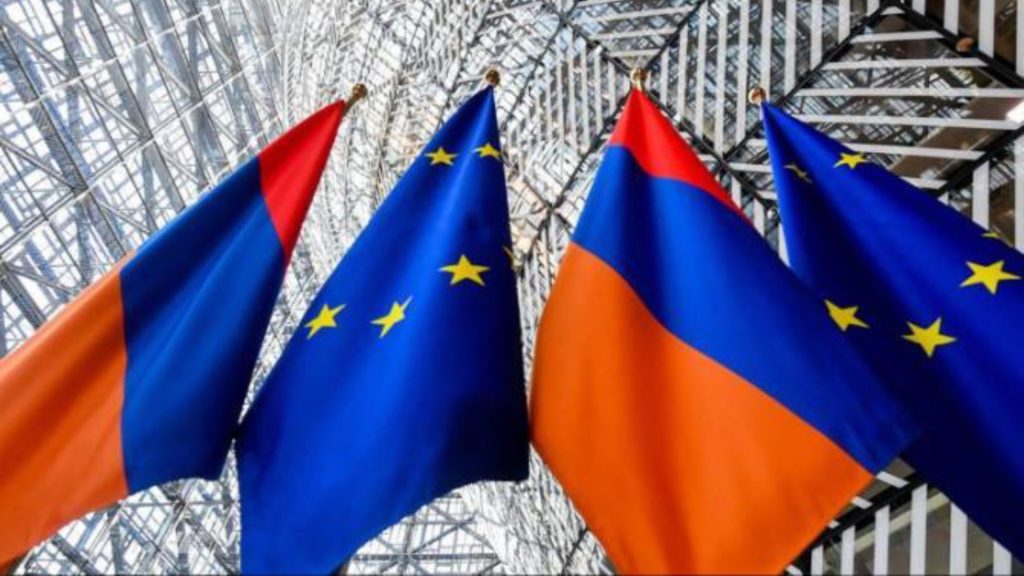
By Sonya Dymova
Parliament Speaker Alen Simonyan signaled last week he expected Armenia to hold a referendum on joining the European Union.
“I think that someday in the near future we will have a referendum, and I am sure that our people will say ‘yes,’” he said in a comment to Latvia’s public broadcaster. Days later, Armenia’s prime minister Nikol Pashinyan appeared to rule out the possibility of such a referendum.
In recent months, the evolving relationship between Armenia and the European Union has become a central topic among the nation's politicians and analysts. The shift comes as Yerevan grapples with questions about its future political alignment following Russia's failure to protect Armenia’s interests in Nagorno-Karabakh during and after the 2020 war.
Samvel Mkrtchyan, the head of the European Department at Armenia’s Foreign Ministry, says the topic is actively discussed now because the country is entering a new stage of cooperation with the bloc.
“It's very logical because this expansion of our relations with the EU started in October last year,” he said, referring to Pashinyan’s appearance in the European Parliament in October 2023.
Some analysts appear more skeptical about the timing. According to Benyamin Poghosyan, founder and chairman of the Center for Political and Economic Strategic Studies and Senior Research Fellow at APRI Armenia, both the non-parliamentary, pro-Western opposition and the ruling Civil Contract party are using Armenia-EU relations in preparation for the country’s 2026 parliamentary elections.
“Armenia’s EU membership is an excellent political platform or election platform: ‘Vote for me, and I will bring Armenia to the EU,’” he said, referring to the non-parliamentary pro-Western opposition.
Poghosyan believes that the country’s ruling party desperately needs positive developments in foreign policy following the devastating losses in Nagorno Karabakh.
“In the last four years, Armenian policy has been a complete failure: war, defeat, war, defeat, destruction of Nagorno-Karabakh, ethnic cleansing of Armenians, occupation of Armenian territory,” he said. “Not a very sound platform to compete in the election.”
It will take Armenia ‘decades’ to join the EU
The U.S.-based Pew Research Center found that, for current, non-founding EU member states, an average of nine years passed between initial candidacy application and actually joining the alliance.
But before a country applies to be a candidate, there lies another time-consuming process — enacting reforms. APRI Armenia Vice President Anahide Pilibossian told CivilNet that the realistic timeframe for Armenia’s accession to the EU is “decades.”
“It takes a long time to get up to speed or at the level that is required, legally, institutionally, and indeed economically, to be a member state of the European Union,” Anahide Pilibossian, Vice President of the Yerevan-based APRI policy research institute, tells CivilNet.
The first milestone on Armenia’s path toward EU membership would be entering a so-called Association Agreement with the bloc. This legally binding framework details various foreign policy, economic and social domestic laws and reforms to be enacted by a candidate country in preparation for its EU accession.
Armenia was on track to sign an Association Agreement with the EU in November 2013 when then-president Serzh Sargsyan gave in to Russia’s pressure to enter the Kremlin-led Eurasian Economic Union instead. This became a dealbreaker for the EU because part of the Association Agreement includes the Deep and Comprehensive Free Trade Area, a free-trade pact between the candidate country and the EU.
“You can't have a free-trade agreement with the EU and a free-trade agreement with the Eurasian Economic Union,” says Pilibossian. “You have to choose.”
But the choice is illusory: according to Poghosyan, today’s Armenia “simply cannot afford to think about leaving.”
The country’s economy depends heavily on Russia, its yearslong leading trade partner. In 2023, Armenia’s exports to Russia amounted to $3.4 billion, while Russian-Armenian trade overall reached an unprecedented $7.3 billion. But there are geopolitical challenges to Armenia’s withdrawal from the Moscow-led economic bloc, too.
“To say that I'm going to leave the Eurasian Economic Union is almost the same as to declare war on Russia,” Poghosyan said. “And I don't think that tiny Armenia, which already has two big, huge enemies, Azerbaijan and Turkey, can afford to also add Russia to this list.”
Cooperation grows even without an Association Agreement
Following Armenia’s move away from the Association Agreement in 2013, the country entered into a different agreement with the European bloc – a Comprehensive And Enhanced Partnership Agreement (CEPA). According to Pilibossian, it has fostered Armenia’s strive for European integration, supporting the country’s social, political, and economic reforms.
Signed in 2017 and enforced since 2021, the document is the leading framework for current Armenia-EU cooperation. It mainly focuses on improving living standards, creating a fair and safe society, and improving Armenia’s education system and approach to climate change.
While trade relations between Armenia and the EU are not up to the level of those with Russia, economic cooperation has deepened in recent years. According to the European Commission, trade with the bloc accounted for about 12.6% of Armenia's total trade in 2023, positioning it as the second-biggest export market of the country.
Sonya Dymova is The Armenia Project summer intern at CivilNet.

 Stories