Civilnet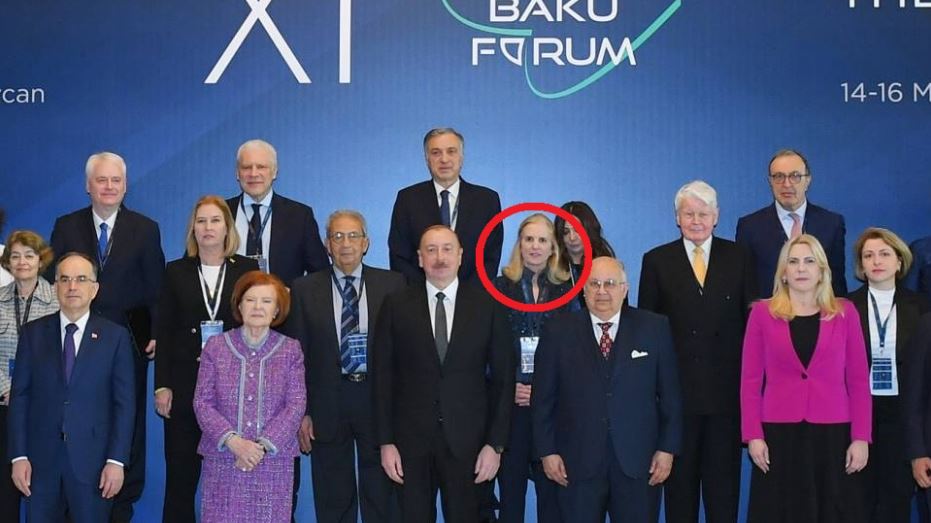
By Paul Vartan Sookiasian
Established in 1968, the Robert F. Kennedy Human Rights non-profit says it works “in pursuit of the dream of a more just and peaceful world.” Yet its active participation with a Baku-based organization funded by the Ilham Aliyev government, perpetrator of repeated human rights abuses, ethnic cleansing, and ruthless internal repression, puts its mission under a cloud.
Robert F. Kennedy Human Rights, aka RFK Human Rights was established in the aftermath of the assassination of the former U.S. Attorney General and U.S. Senator and Presidential candidate and is currently led by his daughter Kerry. According to RFK Human Rights’ website, it is “focused on the protection of civic space―the freedoms of assembly, association, and expression; the right to dissent without fear of reprisal or persecution; the most basic of rights upon which all others are based.” In addition, “RFK Human Rights partners with frontline advocates in all corners of the globe to ensure freedom of civic activism, hold leaders accountable, and speak truth to power at every turn.”
But among the non-profit’s collaborators is also the Nizami Ganjavi International Center (NGIC) in Baku, which is connected with and supported by a government with one of the world’s worst human rights records: Azerbaijan. Kerry Kennedy sits on the Center’s board, and RFK Human Rights partners with it for “an exclusive series [on] the need for international dialogue, understanding, learning, and human rights advocacy.” According to 2020 Foreign Agents Registration Act (FARA) filings by the Washington, D.C.-based lobbyist Blue Star Strategies LLC, “NGIC receives the majority of its funding from the Azeri government.”
In a 2020 Facebook posting, Kerry Kennedy stated that, “I’m so proud to be a Nizami Ganjavi International Center Board Member and be a part of the organization’s inspiring community. Together, we’re working to ensure that every person on this earth lives freely and with dignity.” In line with this, the Baku-based Center purports to be a platform for “learning, tolerance, dialogue, understanding and shared societies” with a mission “to build a dialogue and understanding between cultures and peoples for building functional and inclusive societies.”
A closer look shows that the Center attempts to replicate the Azerbaijani government’s view of the September 2023 ethnic cleansing of the Armenians of Nagorno-Karabakh. This April, it posted a quote from the co-chairman of its board Ismail Serageldin in the wake of the complete depopulation of the region stating that the “Karabakh problem… has been solved.” It also cited President Ilham Aliyev’s demonstrably false claims that Armenians chose to leave the territory willingly, and if they had stayed they would have enjoyed “all the rights enjoyed by the citizens of Azerbaijan.”
When reached for comment, NGIC replied that Serageldin was referring to “the recent acceptance of Armenia that Nagorno Karabakh is an integral part of Azerbaijan as the problem finally being ‘solved’.” It continued “But, of course, there are many complex issues of human rights, including the management of issues of displacement and returnees.”
In the rhetoric of President Aliyev and his government however, the “solving” of the conflict has only ever referred to the result of Azerbaijan’s military attacks on Armenians. For example, just weeks after the September 2023 operation that caused the entire population of Nagorno-Karabakh to flee, Aliyev boasted: “many reiterated that there was no military solution to the conflict. We have shown that there is, and we have shown it again recently. This topic is now closed.”
As NGIC’s primary funder, Aliyev is routinely the keynote speaker at its annual Baku Global Forum, an event which is held under his patronage as well. It purports to be about a wide range of global issues such as intercultural and interfaith dialogue, peace, security, and sustainable development. Despite this, Aliyev’s speeches are almost exclusively focused on vilifying Armenians and providing justifications for his attacks on and ethnic cleansing of them.
For example, at Aliyev’s 2023 keynote, he falsely stated "we did not commit any war crimes," and then in a sentiment that might be considered strange at a peace forum, continued that Azerbaijanis merely "took revenge [against Armenians] on the battlefield."
He further stated “the lives of Armenians living in the Karabakh region of Azerbaijan will be much better than during the occupation [local Armenian governance].” This statement is particularly bemusing considering at the time they were three months into a blockade that culminated in their ethnic cleansing six months later, in what Thomas Becker, legal and policy director at the U.S.-based University Network for Human Rights, told CivilNet was “one of the most egregious examples of rights abuses that I have seen.”
A new investigation by the Organized Crime and Corruption Reporting Project showed that Aliyev’s Foreign Ministry was actively hindering international humanitarian efforts to assist the people of the region, in contravention of the Geneva Conventions.
Kerry Kennedy participated in this year’s Baku Global Forum, which was titled “Fixing the Fractured World.” According to an Azernews report, Kennedy “noted that RFK Human Rights always speaks up against inequality and injustice.”
In fact, she did raise the alarm about Azerbaijan’s assault on Nagorno-Karabakh last September as it was ongoing in two consecutive posts made to the social platform X, warning “the world is on notice of the credible reports of ethnic cleansing of Azerbaijan’s Armenian minority” and urging “the Azerbaijan’s gov’t must provide full enjoyment of fundamental freedoms recognized in the UDHR [Universal Declaration of Human Rights] and allow humanitarian assistance to the people of Nagorno-Karabakh.”
She gained further insight into the ethnic cleansing, as the world watched horrific scenes of people doing whatever they could to escape the approaching Azerbaijani army, from a meeting with former International Criminal Court prosecutor Luis Moreno Ocampo on September 30. Ocampo made headlines in the months prior with his assessment that the blockade against Nagorno-Karabakh could be considered a genocidal action.
In response to CivilNet’s inquiry about the non-profit’s involvement with NGIC, RFK Human Rights replied in an email:
“Kerry is not involved in the day-to-day operations of the NGIC. She was invited to join the NGIC Board to bring a human rights NGO perspective to the table. In this capacity, Kerry advocates for the protection of minorities and accountability for human rights abuses and has consistently denounced the grave human rights violations committed against Armenian minorities in Azerbaijan and called for the protection of civic space in the country.”
A follow-up question about the seeming contradiction of her calls against Azerbaijan’s ethnic cleansing of Nagorno-Karabakh versus her public appearance at a vanity event featuring and funded by its perpetrator did not receive a response.

 Stories