 Civilnet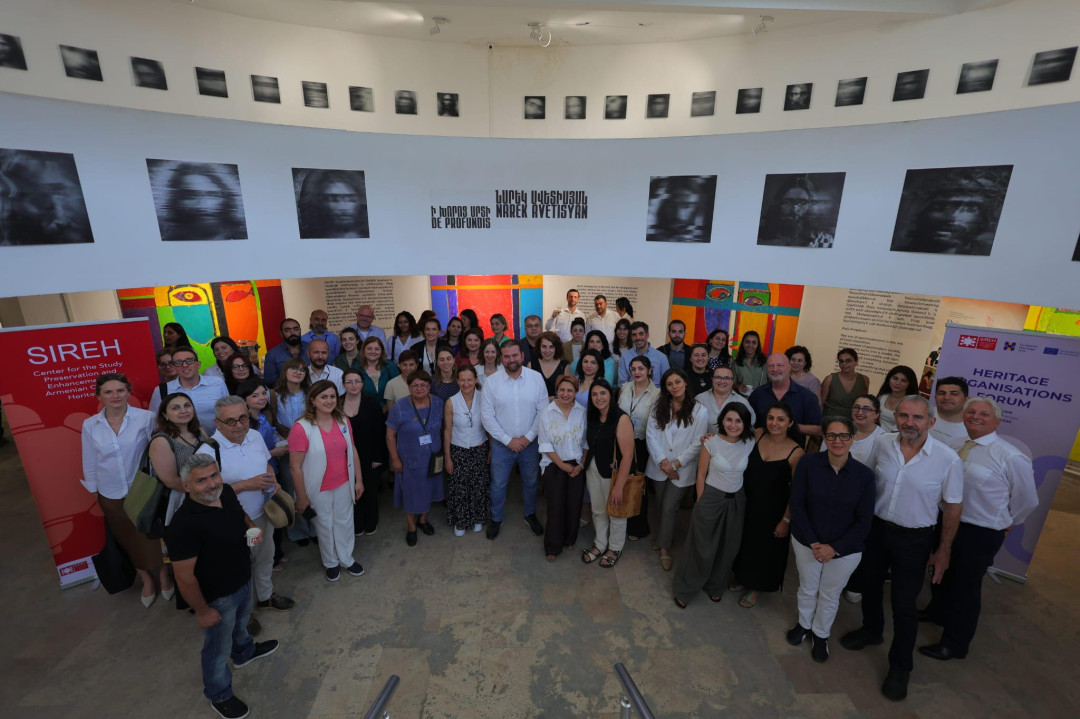
By Minahil Arif
A new survey by the SIREH Center for the Study, Preservation, and Enhancement of Armenian Cultural Heritage revealed that 40% of Armenia’s cultural heritage organisations have been active for less than 5 years. While this indicates a surge in recent heritage-related activities, Gaianè Casnati, scientific director at SIREH, said that many such organisations shut down after almost two years due to lack of financing.
Casnati spoke at the Armenian Heritage Organisations Forum in Yerevan this week. Organized by the SIREH, as well as the European Heritage Hub project and Europa Nostra and co-financed by Creative Europe, the forum was attended by local NGOs, international heritage institutions, donors and diplomatic actors. The event addressed threats to Armenian cultural heritage sites, as well as ways organizations can be supported to continue to preserve these areas.
Participants from the World Monuments Fund, the Getty Conservation Institute, the Embassy of France, ReArmenia, and the EU Program Manager offered insights into heritage preservation and how they can assist in the process.
SIREH conducted the first mapping of civil society organisations active in Armenia in the field of cultural heritage. This was done as part of the European Heritage Hub pilot project, coordinated by Europa Nostra and co-funded by the European Union aimed at highlighting the role of cultural heritage actors in the EU’s neighbouring countries.
While speaking to CivilNet, Casnati said that after mapping 105 organisations, they aim to outreach to the diaspora to collaborate on bridging the current gap, sharing knowledge and avoiding duplication of projects.
The survey was conducted using a questionnaire defined with the Athens Heritage expert Stavroula Thravalou after she visited Armenia in October 2024. The bilingual questionnaire (in English and Armenian) was administered using a Google form. However, obtaining responses was a challenge because of lack of available information on existing organisations. They tried snowball sampling, direct outreach but eventually decided to hire an anthropologist to assist with forming one-on-one connections with organisations.
A major finding of this survey was that lack of financing and institutional support can hinder long-term impact. According to Casnati, there is a lack of concern for such heritage.
“Because people are apparently very passionate with art, architecture, music, and social issues, but then they don't find this a priority,” Casnati told CivilNet.
The takeaways from mapping also include strengths that show civil society organisations have a strong ability to preserve Armenia’s rich heritage but these efforts will remain short-term if the ecosystem stays fragile and unsupported.
Director of the Getty Conservation Institute Tim Whalen shared information about an open-source software called Arches which is a heritage data management resource. It can create modern digital inventories for cities, regions, and countries and organisations can independently deploy to manage cultural heritage data.
Casnati stressed how useful the software could be to create an archive and preserve heritage sites.
Yannis Avramides, Senior Director of Programs of World Monuments Fund, an independent organisation dedicated to safeguarding the world’s treasured places, told CivilNet that their connection to Armenia goes back to the mid-1990s when they assisted with the Conservation Plan for the Basilica of Ererouk.
“If we have the opportunity, we would love to be able to continue our engagement with Armenia. Ideally, identify a suitable heritage site that would create the basis for a broader program that might also address additional needs of the heritage sector in Armenia..,” he added.
He noted that there is a real need for examples and for expertise in the structural repair of monumental historic buildings throughout the country, including famous monasteries and medieval churches. All of these connect to the need to be able to reinforce monuments against earthquakes.
In the afternoon session, multiple speakers explored the need to protect the cultural legacy of Nagorno Karabakh through dialogue, personal experiences, and examples of their work. They focused on preserving cultural sites, emphasizing that such efforts remain vital for Armenians.


 Stories