Explainer: Armenia-Germany Relations Upgraded to Strategic Partnership
 Civilnet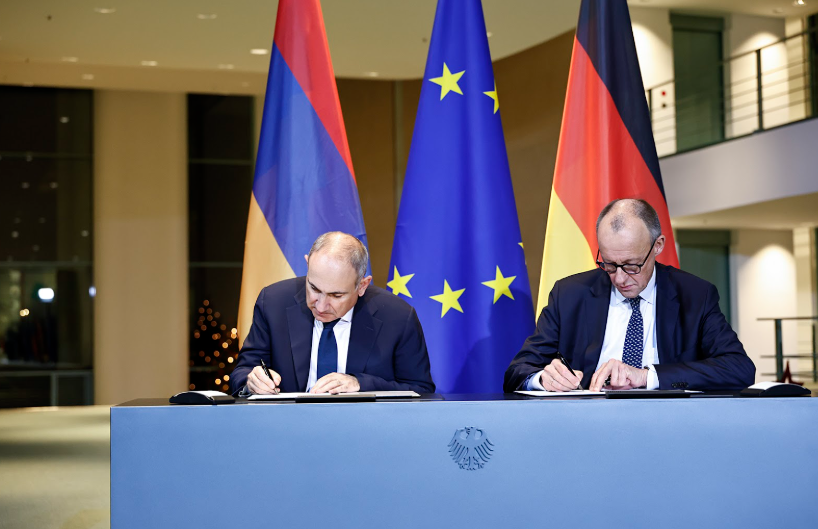
By Paul Vartan Sookiasian
Armenia has signed a strategic partnership agreement with Germany, just one week after signing a similar agreement with the European Union. Prime Minister Nikol Pashnyan and German Chancellor Friedrich Merz signed the agreement Tuesday in Berlin, committing to political, economic, and trade cooperation, capacity building, cultural exchanges, and dialogue on security and defense.
Pashinyan called his visit to Germany “truly historic,” describing Germany as one of Armenia’s main trading partners. According to ArmStat, the national statistical service, trade turnover between Armenia and Germany reached approximately $297.3 million this year through August, mostly by way of German exports to Armenia. This makes Germany Armenia's fifth-largest trading partner overall. By comparison, Armenia-Russian turnover is in the multi-billions annually.
Germany’s main exports to Armenia are cars, machinery, chemicals and electrical engineering products, while Armenian exports to Germany include iron, steel, copper, and molybdenum.
Merz expressed his support for the normalization process between Yerevan and Baku, calling the August 8 White House Summit where both sides initialed the text of a peace treaty “a sign of hope for peace and prosperity in the South Caucasus.”
In a comment to CivilNet, Armenia’s Ambassador to Germany Viktor Yengibaryan called the partnership declaration “a historic event which gives a completely different quality to relations between the two countries.” He noted that while relations are already at a high level, “we realize that the relations have enormous potential, which the signed declaration will contribute to revealing.”
In remarks after the signing, Chancellor Merz discussed the current political situation, saying "the reforms currently being implemented in Armenia are so important," even if sometimes arduous. He also referred to the upcoming June 2026 Armenian parliamentary elections “calling them an essential part of such a democratic development.”
However, he warned that “Russia in particular is trying to scare voters in Armenia about getting too close to Western partners. It spreads falsehoods about the goals and values of the European Union… Russia is attempting to destabilize not only Europe but also Armenia through hybrid measures.”
Multiple German organizations have offices in Yerevan, including the Friedrich-Ebert-Stiftung, Konrad-Adenauer-Stiftung and Heinrich Böll Foundation, which support civic organizations and civil society development and education in Armenia.
Commenting to CivilNet on the timing of the partnership, Stefan Meister, a program head at the German Council on Foreign Relations, pointed to the EU’s growing focus on reducing Russia’s influence in its neighborhood, citing the recent victory of pro-European forces in Moldova’s September elections as an example.
He explained Armenia’s increased importance emerges from Georgia’s democratic backsliding with Russian support, leaving Armenia as the only relatively pluralistic and open country in the region. “With Moscow’s increasing control of Tbilisi, it is not clear whether trade and transit will be able to continue moving through Georgia in the future.”
Vahan Balayan, an analyst of German-Armenian Relations, agreed, telling CivilNet that this overlaps with Armenia’s own goals.
“Prime Minister Pashinyan’s visit and its program have a strong focus on economic cooperation while promoting Armenia’s new peace approach and the region’s stability as a foundation for economic investment from Germany. At the same time, Armenia hopes to secure Germany’s continued support in deepening its relations with the EU,” Balayan said.
As for the future of Armenia-EU relations, Meister said Brussels is serious about visa liberalization, investing in Armenian infrastructure, and countering Russian hybrid threats. Despite that, Armenia is not a candidate for EU membership as Moldova is, considering the geopolitical situation, Russia’s military base in Gyumri and its ownership of much of the country’s strategic infrastructure.


 Stories