 Paul Vartan Sookiasian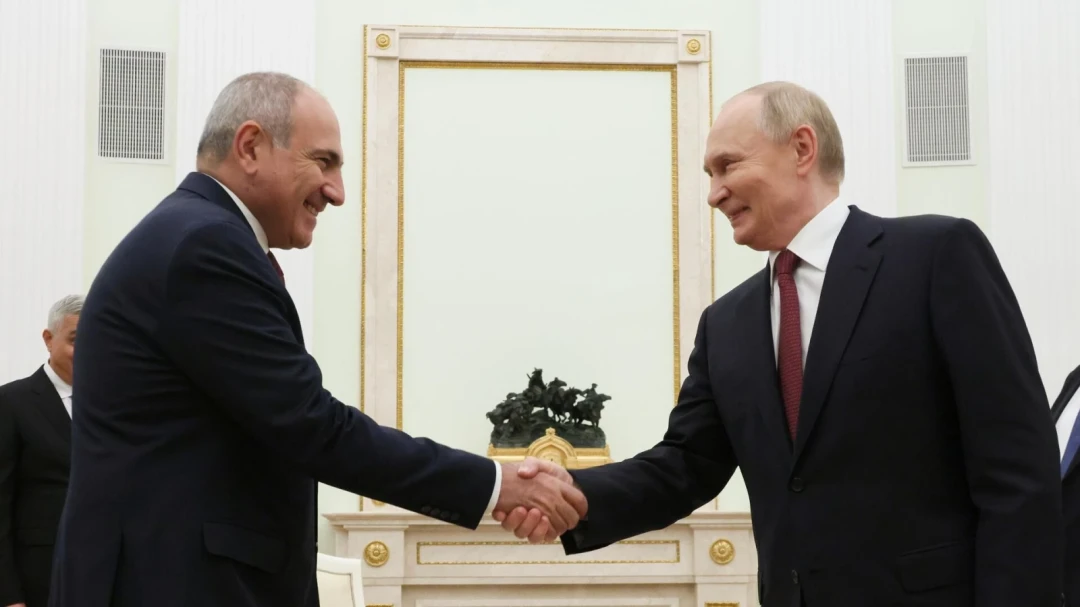
Prime Minister Nikol Pashinyan held a telephone conversation on Monday with Russian President Vladimir Putin, amid escalating tensions between Moscow and Yerevan over Armenia’s diversification of relations with the West.
According to an official readout from the Armenian government, the Russian president congratulated Pashinyan on his birthday and extended his best wishes. The two leaders exchanged views on current bilateral and multilateral issues. Pashinyan reportedly expressed appreciation for what were described as Russia’s “balanced positions” and “friendly tone,” as well as support on a number of issues discussed. The sides agreed to continue contacts at a later date.
No further details were provided on the substance of the conversation.
The call comes after weeks of heightened diplomatic friction, including Moscow’s sharp reaction to Armenia hosting the European Political Community and summit in early May. Russia argued that the event reflected Armenia's growing alignment with Western institutions, with particular anger focused on the participation of Ukrainian President Volodymyr Zelensky, who noted that his drones could reach Moscow’s annual May 9 Victory Day military parade, though such an attack did not occur.
In response, Russian Foreign Ministry spokesperson Maria Zakharova condemned Armenia for allowing Zelensky a platform and criticized Yerevan for not publicly distancing itself from his statements. The Russian Foreign Ministry later summoned Armenia’s ambassador in Moscow to formally protest what it described as the “categorically unacceptable” use of an Armenian-hosted platform.
On Saturday, Moscow recalled its ambassador to Armenia Sergey Kopyrkin for consultations due to Yerevan’s ties with the EU, a move which diplomatically signals deep displeasure with the Armenian government’s trajectory.
In recent weeks, Russia has increased economic pressure on Armenia through restrictions on agricultural imports, including fruits and vegetables, following earlier bans on flowers, mineral water and alcoholic beverages. Armenian officials and commentators have linked these measures to broader political disagreements over foreign policy orientation. Russian officials have also threatened to suspend or terminate a preferential gas supply agreement with Armenia, which could cause prices to skyrocket. Moscow has also been accused of election interference and sponsoring disinformation networks targeting Yerevan ahead of the June 7 Armenian parliamentary elections, in which Pashinyan’s main competitors are widely considered to have a pro-Russian orientation.
Russian officials have also continued to press the view that Armenia must choose between deeper EU integration and continued membership in its Eurasian Economic Union. During an EEU summit last week, the member states’ leaders issued a joint statement urging Armenia to hold a national referendum to choose between EU and EEU membership as soon as possible, and warned that Armenia’s EU pivot poses serious economic risks to their union.
In a video posted on Facebook on Monday, Pashinyan responded that such a vote would only make sense if choosing between the two blocs became unavoidable, and only once Armenia formally approached EU membership. “Before Armenia formally applies for EU membership or comes close to achieving candidate status, holding any referendum would be illogical,” he said.

 Stories