
By Narek Melconian
Civil Contract’s electoral advantage outside Yerevan narrowed by more than one-third between the 2021 and 2026 parliamentary elections. The party’s vote share fell in nine of Armenia’s ten regions, including several that had previously delivered some of its largest majorities.
Pooling the ten regions together, Civil Contract’s vote share fell from 61% in 2021 to 53% in 2026. Its lead over Yerevan, where the party received roughly 41% in both elections, consequently narrowed from nearly 20 percentage points to 12 points.
The shift was concentrated in areas that had previously formed the backbone of Civil Contract’s electoral support. Lori recorded the sharpest decline, at -10.9 percentage points, followed by Gegharkunik (-9.9 points), Shirak (-9.5 points), Tavush (8.7 points) and Armavir (-8.0 points).
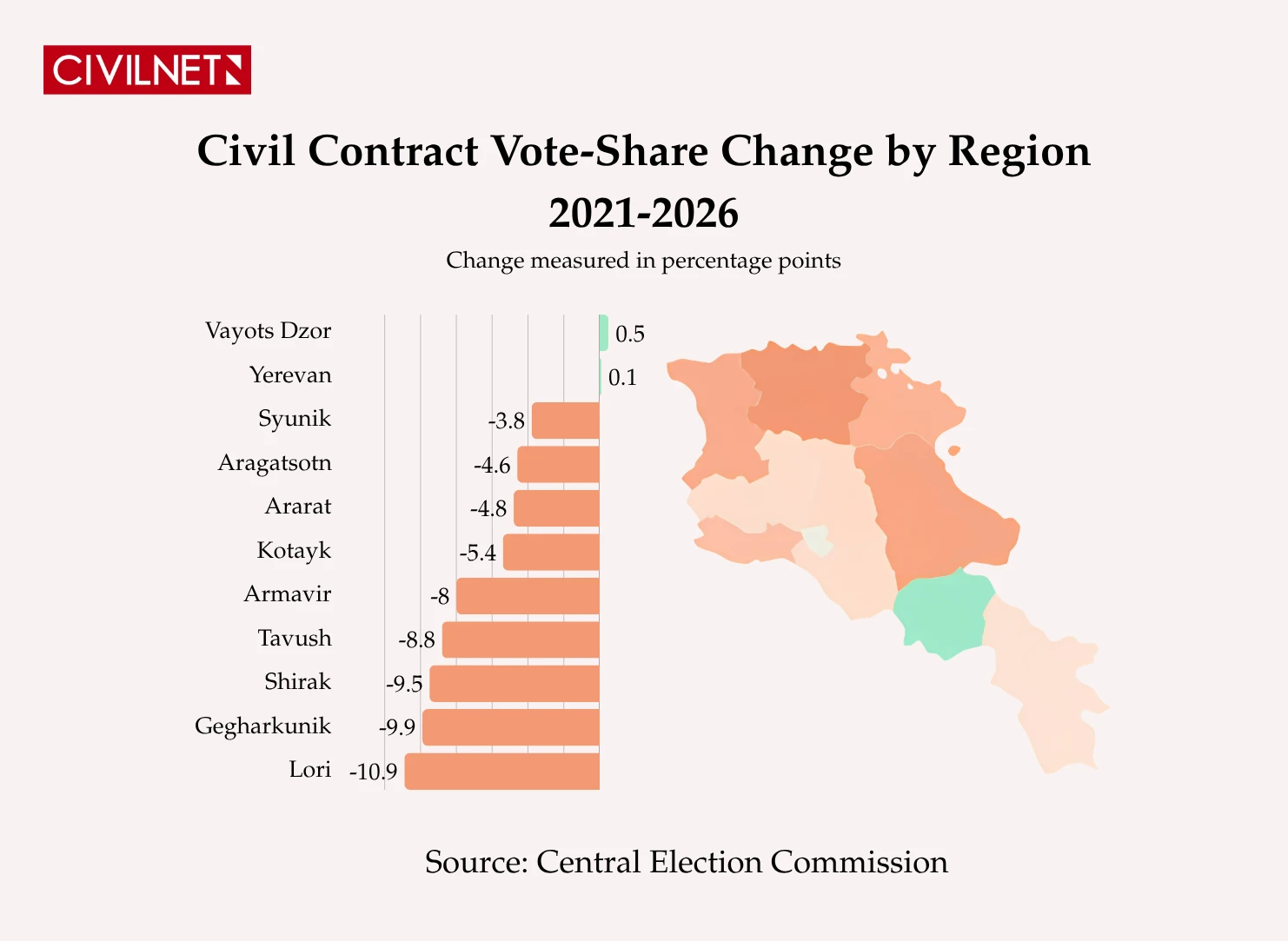
The regional decline was partly obscured by the national outcome. Civil Contract still received 49.8% of the vote and secured 64 of the National Assembly’s 105 seats, retaining its parliamentary majority. But the result rested on narrower regional margins than the party’s previous victory.
That distinction matters because Civil Contract has consistently performed better outside the capital. Armenia is divided into ten regions, known as “marzes”, while Yerevan is administered separately. In both the 2021 and 2026 elections, the party received around 41% in Yerevan but performed better in every marz.
The 2026 election therefore preserved Civil Contract’s familiar electoral map while eroding its regional advantage. The party’s total vote nevertheless increased from around 689,000 in 2021 to 727,000 in 2026, an additional roughly 38,000 votes. Civil Contract did not lose its electorate in absolute terms, but rather, a larger and more competitive election reduced its share of the vote and narrowed the margins delivered by the regions. The marzes still returned the party to power, but they no longer provided the overwhelming advantage recorded five years earlier.





 Stories