By Nicholas Castillo
The World Bank’s Yerevan office has released its summer 2026 report on poverty reduction and fiscal policy in Armenia, arguing “Armenia’s economy is transitioning from the exceptionally strong growth rebound phase of 2022-2025 toward a moderate growth path.” The report points to increased regional uncertainties and enduring challenges for the country, recommending a shift to better social protections, productivity, an increase in formal employment and development of high-skill sectors.
CivilNet attended the launch of the report, titled “Economic Pulse: Pursuing Poverty-Reducing Growth with More Impactful Fiscal Policy.”
Growth, poverty, and fiscal policy
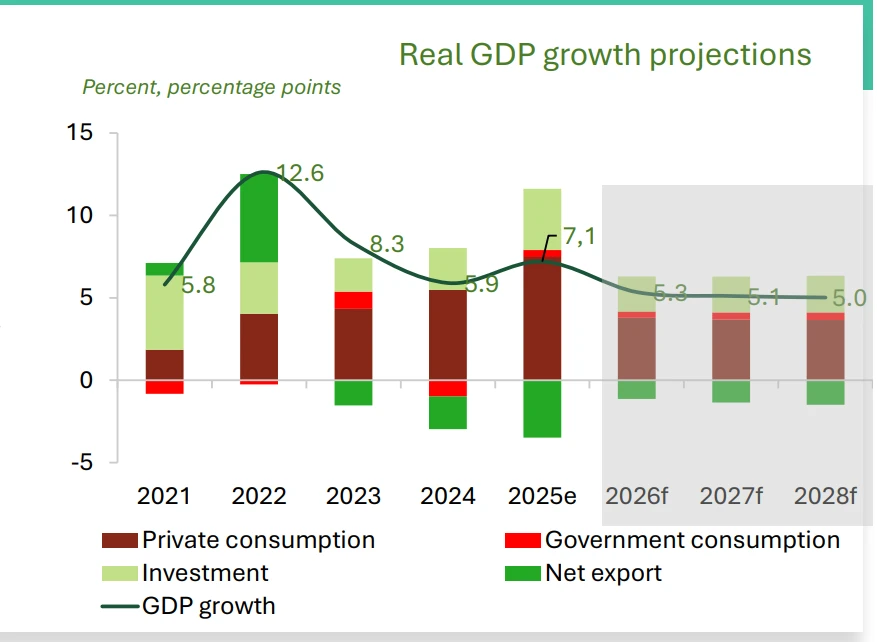
The World Bank predicts that Armenia will experience 5.3% GDP growth in 2026. The more moderate growth expected in the coming years pales in comparison to the 12.6% reached in 2022. The bank also reports a drop in unemployment to 12.8% in 2025.
Wage growth in Armenia has slowed from its 2023 peak of 12.4% to 2.2% in 2025, despite continued growth in the ICT, financial services, and administrative sectors. At the same time, inflationary pressures have intensified, as Armenia experienced deflation throughout 2024, primarily driven by rising food prices.
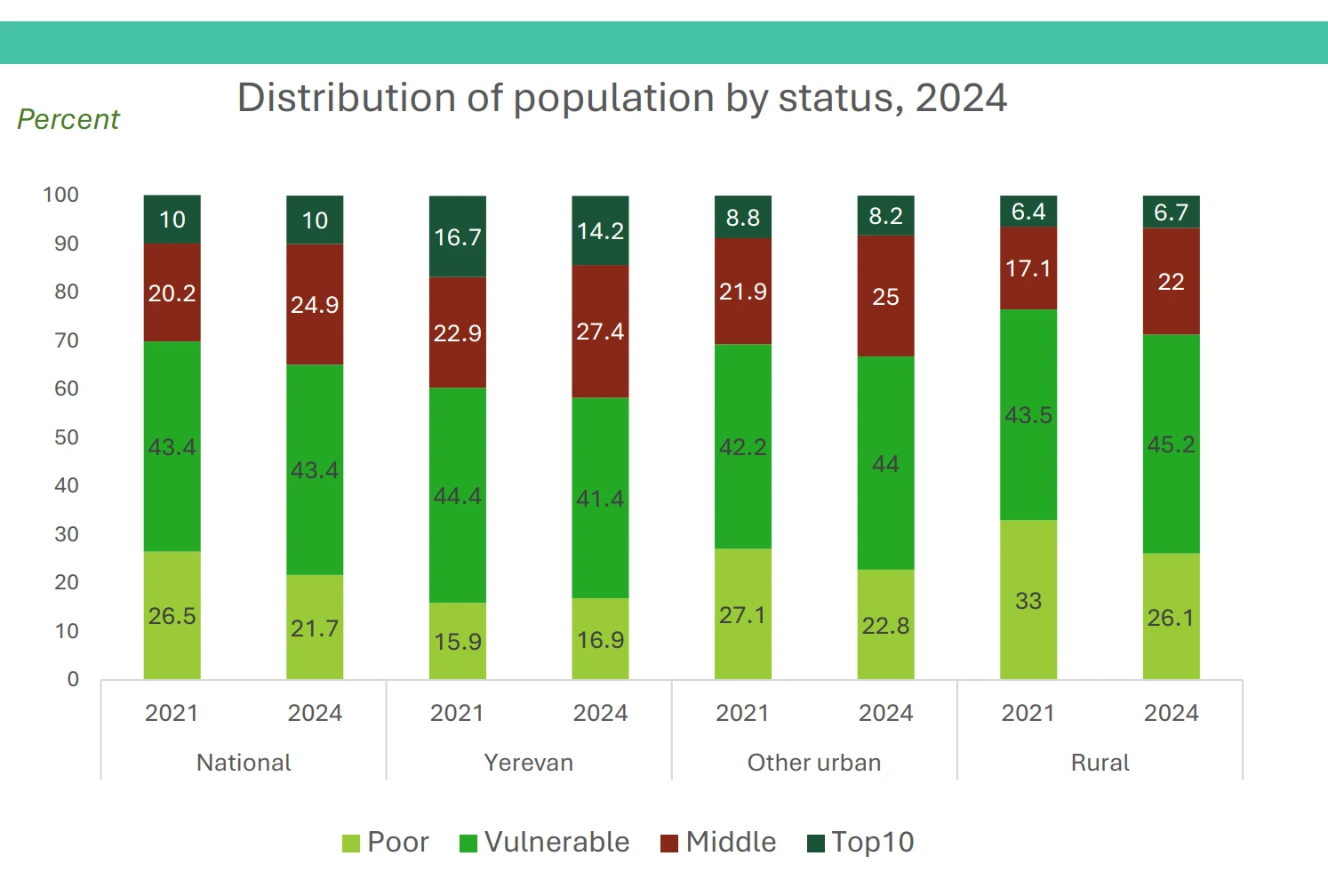
Meanwhile, while poverty has shrunk from 26.5% to 21.7% of the population since 2021, the World Bank details persistent challenges in the Armenian economy as it relates to poverty, inequality, and the level of skilled labor present in the country.
The share of Armenians qualified as economically “vulnerable” remained unchanged between 2021 and 2024, at 41.3%, referring to those who may be one economic shock away from falling into poverty. Yerevan specifically showed more positive dynamics around economic vulnerability, with the vulnerable share of the city’s population shrinking from 44.4% to 41.4% since 2021 as the number of middle-income residents grew.
In rural regions, while the share of those in poverty shrank from 33% to 26.1%, the number of those qualified as vulnerable increased from 43.5 to 45.2%. Yet, the share of middle-income Armenians in rural regions has also grown, from 17.1% in 2021 to 22% in 2024.
Statistics on poverty for 2025 are expected to be released in the near future.
Another long-term problem for Armenia, the share of Armenian workers engaged in skilled labor remains low, in part caused by low rates of secondary education among Armenian citizens. The World Bank points out that as Armenia’s population ages and the country works toward digitalization, a shortage of skilled labor could constrain its economic potential. In rural areas especially, large shares of Armenians remain in low-productivity jobs, self-employment, and informal work.
The country also continues to struggle with high rates of informal non-contracted labor, limiting citizens’ access to benefits, such as pensions, and tax revenues for Yerevan.
The report concludes that “Armenia’s progress against poverty has been real, but it rests on fragile foundations that labor markets alone cannot fix.” Rather, it argues, Armenia should work to provide higher quality jobs, higher productivity, and more formalized employment.
Even noting that Yerevan’s fiscal policies, such as pensions and direct assistance, have reduced poverty by 2.2%, the report recommends that the government “introduce compensatory mechanisms to offset the regressivity of indirect taxes” and adopt “a more balanced and resilient fiscal policy framework.”
Regional pressures and uncertainty
A theme of the forecast released by the World Bank is the increasing pressures and regional uncertainty facing Armenia.
The two primary sources of uncertainty are the deteriorating trade relations with Russia and the economic consequences of the ongoing US-Israel-Iran war.
Prior to the war with Iran, the World Bank had predicted Armenia’s growth to reach 5.9% for 2026 before being revised down to 5.3% as a consequence of the conflict.
Armine Manukyan, a senior economist at the World Bank, told CivilNet that Armenia had avoided more severe shocks because Iranian gas prices were fixed prior to the outbreak of the conflict. But with Armenia intertwined with Iran economically and with the possibilities of future gas price hikes, ongoing instability to Armenia’s south adds unpredictability and potential shocks for the country.
Despite these risks, Armenian and Iranian officials entered into talks on increasing Tehran’s gas shipments to Armenia, a sign of growing commercial ties.
Another substantial regional risk to Armenia’s economy is the ongoing trade tensions with Russia. In recent months, Russia has introduced increasingly sweeping bans across Armenia’s agricultural sector in response to Yerevan’s growing relations with the European Union, most recently barring Armenian dairy products this month. Moscow has additionally raised the prospect of ending preferential pricing for Armenian consumers of Russian gas.
With the overwhelming role of Russia in Armenia’s energy and trade, such moves pose serious risks to Armenia’s economy. Agriculture alone employs 1 in 4 Armenians, and is an especially prominent source of employment among the poor and economically vulnerable.
In response, Armenia and the European Union have announced new measures to grant Armenia greater access to European markets and pledged millions of Euros in trade assistance.
The data included in the recently published report largely does not reflect this most recent period, with Manukyan telling CivilNet that more time and research would be necessary to determine the impact of the trade conflict and the effectiveness of Armenian and European efforts to mitigate them.
The bank report also notes potential positive changes in the regional dynamic that could benefit Armenia, namely the potential normalization of relations with Turkey and Azerbaijan, which could open up Armenia to large neighboring economies.
A changing economic environment
The years since Russia’s 2022 invasion of Ukraine have seen unusually high growth in Armenia driven by an influx of cash-rich Russians and firms taking advantage of new routes for sanctions evasion that pass goods through Armenia and on to Russia.
While these were not the only factors driving growth in Armenia, these temporary economic boosts did produce an extraordinary economic environment marked by high levels of investment, consumption, and exports.
Such growth has shown up in the lives of everyday Armenians, helping to fund a large public spending blitz as tax revenues grew, some social safety net expansion, and new opportunities.
Yet, as the World Bank reports, this period is now subsiding into one of more normalized economic growth. At the same time, the international environment, which once provided Yerevan with opportunities, is now generating new risks for Armenian firms and consumers.
As the post-2022 economic boost subsides, it remains to be seen how Yerevan will pivot its economic strategy and whether authorities pick up the World Bank’s recommendations.



 Stories