By Lia Avagyan
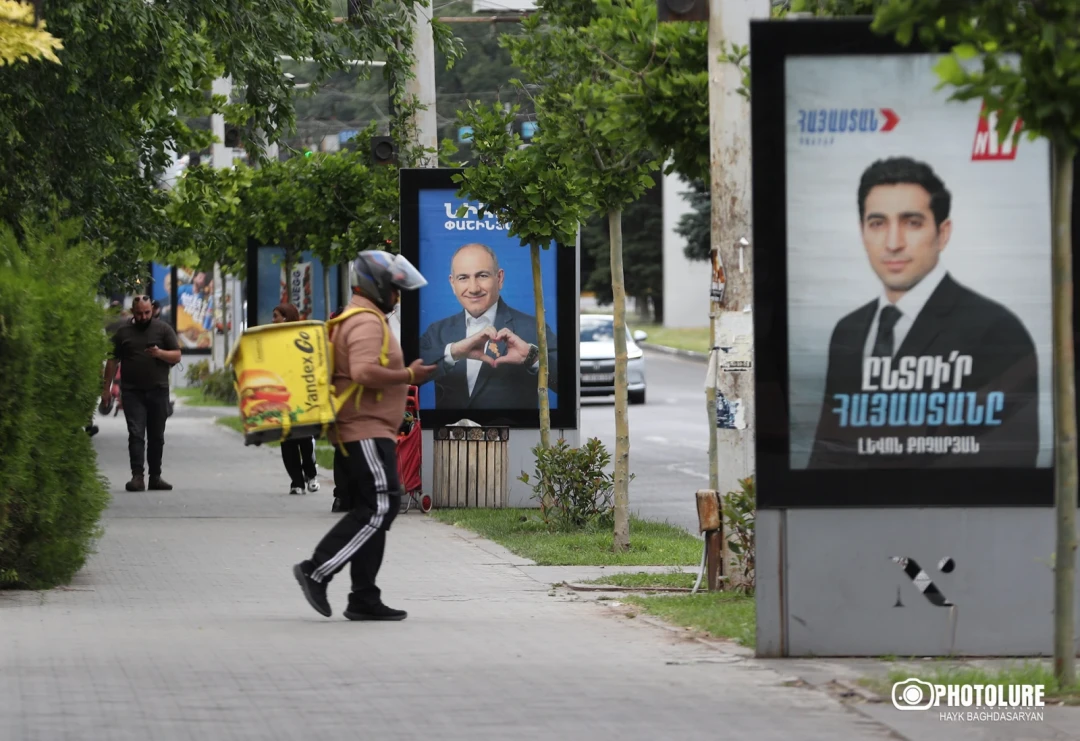
On June 7, Armenian citizens will cast their ballots and answer a fundamental question: what kind of Armenia do they want to see over the next five years?
Sunday’s parliamentary elections will shape the country’s direction for the foreseeable future. It is the first regularly scheduled parliamentary election since the 2018 Velvet Revolution.
Prime Minister Nikol Pashinyan won a landslide 70 percent of the vote in the snap election held in December 2018. In another snap election in June 2021, he retained power with 54 percent support despite Armenia’s defeat in the 2020 Nagorno-Karabakh war. Voter turnout stood at 48.6 percent in 2018 and 49.4 percent in 2021.
This year, voters will choose among 16 parties and two electoral alliances.
According to opinion polls, Pashinyan’s Civil Contract party remains the frontrunner. A distant second is the Strong Armenia Alliance led by billionaire Samvel Karapetyan, followed by the Armenia Alliance of former President Robert Kocharyan, whose main constituent force is the Armenian Revolutionary Federation (Dashnaktsutyun).
Pashinyan leads, but uncertainty looms ahead of Sunday's vote, CRRC poll shows
The month-long campaign has focused on several key issues: the Armenia-Azerbaijan peace process and national security, Armenia’s geopolitical orientation between Russia and the West, and economic concerns such as jobs and social programs. The fate of Armenian prisoners and detainees held in Azerbaijan also featured in the campaign, though it remained a secondary issue compared with debates over security, foreign policy, and the economy.
Polling stations will open across Armenia at 8 a.m. and close at 8 p.m. on election day. Armenia does not generally allow voting from abroad, meaning only citizens physically present in the country can cast a ballot. The only exception is for diplomats and their family members serving overseas.
Armenia’s electoral system can be difficult to understand even for seasoned observers. CivilNet has prepared a simple guide explaining how parliamentary seats are allocated and how the parliament ultimately chooses the prime minister.
Also Read: Who is who in Armenia’s 2026 elections?
One of the campaign’s central debates has been Armenia’s foreign policy trajectory. Should the country continue moving closer to Europe, or maintain its traditional partnership with Russia and Moscow-led blocs? We examined where the main political forces stand on this question.
Where do Armenian parties stand on Russia and the West?
The campaign has also been overshadowed by allegations of foreign interference. Several media outlets reported on possible Russian efforts to influence the election, including claims about transporting voters from Russia to Armenia. CivilNet conducted its own investigation into these allegations.
In the weeks leading up to the vote, Moscow openly increased economic pressure on Armenia, restricting access for several Armenian products to the Russian market. The European Union, meanwhile, announced new trade preferences aimed at helping Armenian exporters offset the impact of Russian measures.
Russia has largely backed pro-Russian candidates and parties in the election, while Western governments have been widely perceived as favoring Prime Minister Nikol Pashinyan. U.S. Vice President JD Vance’s visit to Armenia in February and his public backing of Pashinyan, as well as the European Political Community summit and the first EU-Armenia summit held in Yerevan in May, were seen by many observers as signs of Western support. In late May, U.S. Secretary of State Marco Rubio made a brief visit to Armenia to sign several bilateral agreements, followed by President Donald Trump’s public support for “his friend Pashinyan.”



 Stories