By Nicholas Castillo
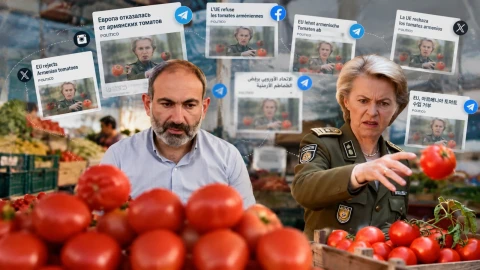
As Armenia nears its June 7 national elections, relations with Russia have entered a more strenuous phase. Recent weeks have seen Moscow take an increasingly punitive approach to Yerevan’s growing relations with Europe. Armenian imports have been banned, there is talk of ending favorable gas prices, and in late May the Kremlin recalled its ambassador for “consultations” on Armenia’s growing ties to the European Union (EU).
With Yerevan’s recent foreign policy shifts, the parties vying for parliament have articulated their approaches to Russia, the EU, and the future of Armenia’s international alignment. CivilNet breaks down the foreign policy positions of Armenia’s leading political parties.
The Governing Team: Civil Contract
Civil Contract’s eight years in government have been marked by a gradual reorientation of Armenia’s foreign policy. While the party has sought to strengthen ties with the West, its economic dependence on Russia has remained significant and, in some areas, deepened during this period.
Nikol Pashinyan’s government has moved to strengthen ties with the West. This has produced the U.S.-backed Trump Route for International Peace and Prosperity (TRIPP) project, a burgeoning interest in joining the European Union, and more symbolic steps such as Yerevan hosting the European Political Community summit last month.
Civil Contract’s platform notes that relations with Russia are in a period of “constructive transformation” and promises to develop new mutually beneficial relations with Moscow. Alongside other multilateral organizations, Civil Contract’s platform also endorses Armenia’s participation in the 3+3 platform, a South Caucasus regional dialogue framework intended to bring together Armenia, Azerbaijan, Georgia, Russia, Turkey, and Iran to discuss security, transport, and cooperation after the 2020 war.
The party promises not to return to active participation in the Collective Security Treaty Organization (CSTO), the Moscow-led security bloc in which Yerevan froze its membership after no assistance was provided to it during Azerbaijan’s 2022 incursions into Armenia’s internationally recognized territory. However, the platform comments on the fact that Armenia will remain a member of the Russian-backed Eurasian Economic Union (EEU) “as long as reforms aimed at rapprochement with the EU and compliance with the EU membership criteria are compatible with membership in the EEU.”
Also read: EXPLAINER: Can Armenia achieve visa-free travel to EU?
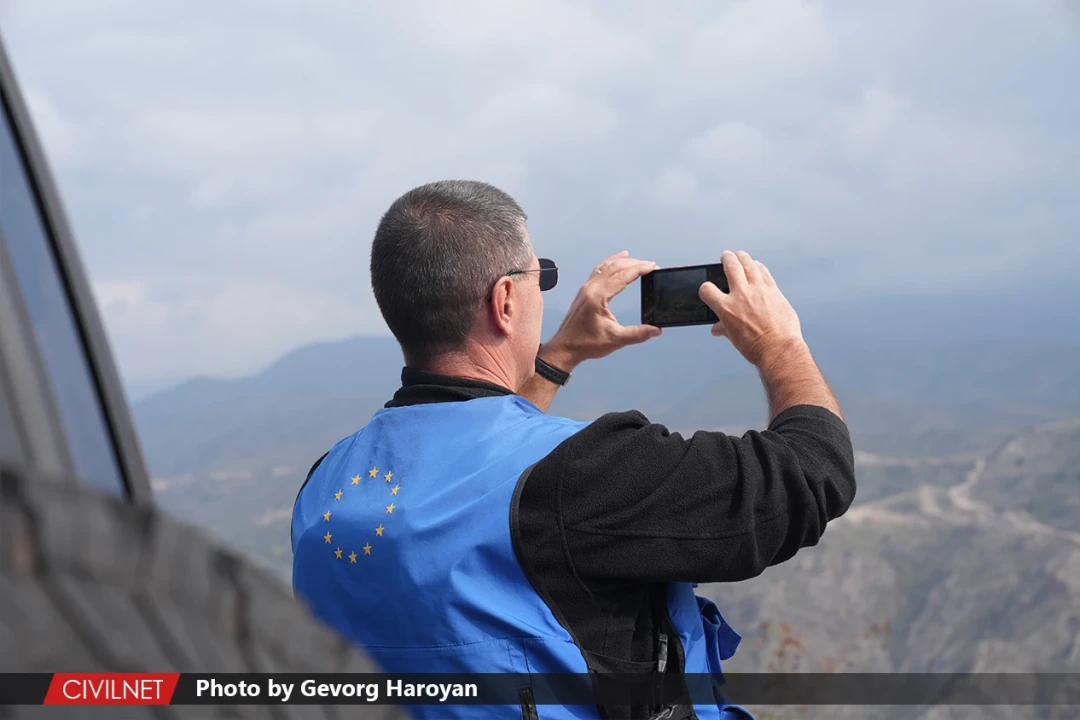
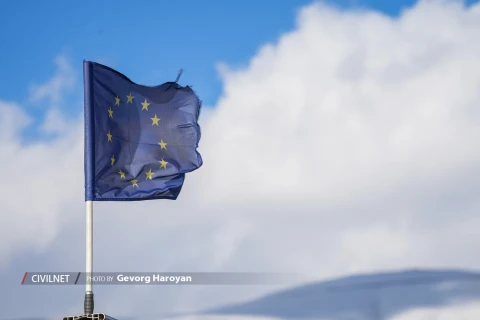
As for the European Union, the manifesto is more specific. It celebrates developments under Civil Contract, including the arrival of EU monitoring teams, the passage of legislation declaring accession ambitions, and the start of visa normalization talks. The platform says Civil Contract will carry out the reforms necessary for EU membership, but is vague about eventual plans for accession. According to the party, once Armenia is able to meet European standards, EU membership will become a “political question” to be decided at that point.
Also read: Who is who in Armenia’s 2026 elections?
Pro-Russian Opposition
Strong Armenia
Strong Armenia, led by Russian-Armenian billionaire Samvel Karapetyan, typically ranks second in opinion polls, making it the leading opposition party. In addition to Armenia, Karapetyan is a citizen of Russia and Cyprus, which bars him from holding the office of Prime Minister or becoming a member of parliament. The billionaire also maintains business interests in Russia, as reports of Kremlin backing for pro-Russian election contenders have surfaced throughout the campaign.
Strong Armenia’s pre-electoral manifesto goes into more detail on its approach to Russia and the EU. It calls for “strategic cooperation” with Russia, and for Armenia to “make the most of” its participation in the EEU by expanding its access to markets in the bloc. The platform also says that Armenia must increase its participation in the CSTO, while simultaneously endorsing the formation of new defense partnerships. At the same time, the document calls for deeper relations with the EU, referring to the “localization of European best practices” as a “key component of development.” It pledges a “comprehensive” partnership with Brussels.
Also read: What Armenia’s prime minister candidates say about TRIPP
Karapetyan’s team has struck a balanced tone on Yerevan’s growing relationship with Washington. Karapetyan himself has promised not to cancel the TRIPP agreement, but to revise it to some degree. Narek Karapetyan, Samvel Karapetyan’s nephew and formal Prime Ministerial candidate in this year’s election, has said the TRIPP initiative presents both opportunities and dangers. “Our broader foreign policy vision is that any peace agreement must have more than one guarantor,” the younger Karapetyan remarked in January. In May, however, Narek filmed a video of himself in the Syunik region arguing that the TRIPP route could become a target for Iranian attacks.
Armenia Alliance
Seemingly the most explicitly pro-Russian major party, Armenia Alliance (which includes the Armenian Revolutionary Federation) is the vehicle of former Armenian President Robert Kocharyan. Kocharyan has said a potential split with Russia would “simply be catastrophic” for Armenia’s economy. The former president has also called for a “restoration” of Armenia’s strategic partnership with Russia.
Kocharyan has framed Pashinyan’s approach to the EU and Russia as irresponsible.
“Russia is extremely patient [with Armenia],” he said earlier last month. “But the approach is this: if you are a friendly country [with Russia], a trade regime operates with you. If you come out of the status of a friend and move towards countries that are currently in hostile relations with Russia, then you may find yourself in other regimes.”
As for TRIPP and the United States, Kocharyan is the only major candidate to explicitly reject the project, arguing that “TRIPP is an Armenian-American project for Azerbaijan and Turkey.” The former president has also said that the United States has no real economic interests in the South Caucasus, and that the TRIPP project represents a potential flash-point between the U.S. and Iran.
The Armenia Alliance has not released a formal manifesto outlining party priorities. Because it is an alliance of two smaller parties, as opposed to 4% for single parties, it requires an 8% vote share to cross the threshold and enter parliament - more than the level the party typically polls at.
Prosperous Armenia
Prosperous Armenia, led by Armenian business tycoon Gagik Tsarukyan, is one of the smaller parties that may cross the 4% electoral threshold and take seats in the National Assembly. Tsarukyan has been involved in politics off-and-on since the early 2000s, but this election cycle has seen his party face legal pressure and allegations of cooperation with Russia. Tsarukyan also has longstanding ties to Belarusian President Alexander Lukashenko.
While the party’s platform endorses a “balanced foreign policy that excludes unilateral dependence on any one power center,” it describes Russia and Iran as “key allies in the areas of regional security, energy and transport connectivity” while calling for “cooperation in the areas of investment, technology, institutional development and economic modernization” with the EU and the United States. On the campaign trail, Tsarukyan has stressed the importance of ties to Russia and lamented their deterioration.
Pro-Western Opposition
Wings of Unity
Most other parties are struggling to overcome the electoral threshold. One such party is Wings of Unity, led by former deputy justice minister andOmbudsman Arman Tatoyan.
Wings of Unity’s platform calls for increased military cooperation with France and the United States, two military partners Armenia has increasingly worked with in recent years. The party also endorses the U.S. TRIPP initiative. It goes on to call for “constructive dialogue with all regional countries, other international partners and actors.” The document names Russia, alongside the EU, as one such partner.
Tatoyan has also sought to engage the Trump administration during the campaign. Ahead of Vice President JD Vance’s visit to Yerevan in February, he publicly called on the White House to deepen its engagement in the South Caucasus, praising Trump’s efforts in the region and the agreement establishing the TRIPP project.
Additionally, Tatoyan has suggested that the United States may help Yerevan secure the departure of Azerbaijani troops from Armenian border territories occupied in 2022, going as far as to suggest naming strategically important areas after Donald and Melania Trump.
Armenian Meritocratic Party
Led by Gurgen Simonyan, the Armenian Meritocratic Party is a newly founded party. A group that also may struggle to enter parliament, the party represents one of the more explicitly pro-Western factions in Armenia.
While the party has not submitted a formal platform to the electoral commission, Simonyan has stood out for his pledges to exit from Russian-backed intergovernmental organizations in the coming years. These include the EEU, the CSTO, and the Commonwealth of Independent States (CIS). He has argued that Armenia should elevate relations with the EU and take steps toward European reforms.
The Republic Party
Another small pro-European force, the Republic Party, is led by long-standing political figure Aram Sargsyan. It also appears to have little chance of crossing the electoral threshold. The Republic Party is the only party in the campaign to have publicly stated that it is ready to form a coalition with Pashinyan’s Civil Contract party after the election.
The party was also among the pro-Western political forces and civic groups that launched a signature-gathering campaign in 2024 to initiate Armenia’s EU accession process. The initiative collected enough signatures to force parliamentary consideration and was later taken up by the ruling party, which turned it into a declarative, non-binding law..
One of the more radical pro-EU parties, Sargsyan’s platform pledges to withdraw from the CSTO, EEU, and CIS. Additionally, it seeks to establish a new relationship with Russia, “canceling” the foundational agreements of the post-independence Yerevan-Moscow relations.
The manifesto also argues Armenia should align with “states that share democratic values,” accelerate the implementation of TRIPP, and meet the economic prerequisites for EU membership by 2032. The party also advocates increased military cooperation with France and the United States, suggesting Armenia should partner up with them on nuclear power plant construction.
Also read: How Armenia’s parliamentary seats are allocated after the election
Nicholas Castillo is a graduate of George Washington University and a master's student in Regional Studies at Harvard University. He is currently a TAP (The Armenia Project) intern at CivilNet and writes on the South Caucasus, Russia, and Eastern Europe.

 Stories